Cafe Roubaix

Despre ciclismul de azi şi cel de altădată

Rider of the week

Bradley Wiggins put on an insane 59×14 gear and a blistering ride in order to become the newest member of the Hour Record club, stopping the clock after 54,526 kilometers, even though the 1036mb air pressure was a huge obstacle in his path and slowed him down throughout the event. By setting a new mark on the Lee Valley Velodrome in London – where he was in the attendance at the 2012 Olympics – the 35-year-old became the sixth ever Tour de France winner to break the Hour Record, following in the footsteps of Lucien Petit-Breton, Fausto Coppi, Jacques Anquetil, Eddy Merckx and Miguel Indurain.

If not for the high air pressure conditions in the UK capital, The Brit surely would have reached his target of 55 kilometers, that would have undoubtly put the Hour Record to bed for a couple of years. Still, his performance – which eclipsed the one of his fellow countryman Alex Dowsett (52,937 kilometers) – remains an impressive one and it will take an incredible ride from the future contenders to surpass this mark which helped Wiggins crown an outstanding career that will continue until the 2016 Rio de Janeiro Olympics.

The Brit isn’t the most spectacular cyclist out there (and he never pretented to be), but for sure is the most versatile one, and his results speak on behalf of himself: Tour de France, Paris-Nice, Criterium du Dauphiné, Tour de Romandie, Tour of California, Tour of Britain, World and Olympic individual time trial champion, multiple World and Olympic track champion and now Hour Record holder, he has them all in his palmares, one of the best a rider has seen in the past decades, although many are still reluctant to asses his achievements. This matters less, so in the end, love him or hate him, Bradley Wiggins will go down in history as a real legend of the sport.

Bradley Wiggins – new Hour Record: 54,526 km/h

Bradley Wiggins Hour Record

Criterium du Dauphiné Stats

Criterium du Dauphiné 2015

Historical stats

– Bernard Hinault, Nello Lauredi, Charly Mottet and Luis Ocaña share the record for the most wins, 3

– France leads in an all-time nation standings, with 30 victories

– Australia (Phil Anderson), Colombia (Martin Ramirez, Luis Herrera), Kazahstan (Alexander Vinokourov) and U.S.A. (Tyler Hamilton, Greg LeMond, Andrew Talansky) are the countries from outside of Europe that have won the race

– 13 countries have had a champion in the Dauphiné; surprinsingly, Italy isn’t on the list

– Thierry Claveyrolat holds the record for the most points jersey (3) and mountains jersey (5)

– When it comes to stage wins, Bernard Hinault has the most victories – 10 – as well as the most days in the yellow jersey, 19

– The longest edition had 1935 kilometers and took place in 1956, when Belgium’s Alex Close finished first

– Grenoble is the city which featured the most times in the race

–Jacques Anquetil, Louison Bobet, Chris Froome, Bernard Hinault, Miguel Indurain, Eddy Merckx, Luis Ocaña, Bernard Thévenet, Bradley Wiggins and Chris Froome have all won the Criterium du Dauphiné and the Tour de France in the same season

– Cadel Evans has the most podiums – 5 – without winning the general classification

– In 2001, Christophe Moreau defeated Pavel Tonkov for just one second, smallest ever gap

– Biggest winning margin was recorded in 1981, when Bernard Hinault put 12:07 to Portugal’s Joaquim Agostinho

– Greg LeMond is the youngest ever winner (21 years in 1983), while Christophe Moreau is the oldest one (36 years in 2007)

2015 stats

– 21 teams (17 World Tour, 4 Pro Continental) will race the 67th running of the event

– Of these, six haven’t scored a World Tour victory in 2015: Bora-Argon 18, Cofidis, Europcar, IAM Cycling, LottoNL-Jumbo and MTN-Qhubeka

– The course includes a team time trial and three summit finishes: Villard-de-Lans, Saint-Gervais Mont Blanc and Modane Valfréjus

– Three former winners will be at the start: Chris Froome, Andrew Talansky and Alejandro Valverde

– The cyclists in the 2015 race have won a combined total of 5 Grand Tours, 9 Monuments, 3 world titles, and more than 100 Grand Tour stages

– Youngest rider in this year’s race is Tiesj Benoot, 21 years; oldest one is Spain’s Haimar Zubeldia, 38 years

– 35 countries will have at least one cyclist in the race, with France topping the list (31)

June on Cafe Roubaix

The Giro d’Italia is done and dusted, and although people are now waiting for the Tour de France, with the excitement and hype growing day by day, they shouldn’t forget that the Criterium du Dauphiné and the Tour de Suisse are still to take place, races in which we’ll see the Grande Boucle favorites test their form ahead of their July goal. Due to some personal reasons, you won’t find a preview of these events here, as well as other cycling news, but this doesn’t mean you can’t come here from time to time, as there will be plenty of things to read about.

As it goes, in the following weeks I will publish some interesting stats on the Dauphiné and Suisse and a couple of interviews with some of the most talented young riders of the moment, cyclists like Pascal Eenkhoorn, Laurens De Plus or Keegan Swirbul, who are all poised to have a great future once they’ll turn pro. As was the case in the past years, later in the month you’ll find the list of the national champions and the startlist (as well as other info) of the Tour de France. Of course, you can check also the 2015 Results piece, which will be updated every time a race takes place.

World Tour standings after the Giro d’Italia

Individual

1 – Alejandro Valverde – 338 points

2 – Alberto Contador – 307 points

3 – Richie Porte – 304 points

4 – Alexander Kristoff – 237 points

5 – John Degenkolb – 234 points

6 – Joaquim Rodriguez – 230 points

7 – Fabio Aru – 212 points

8 – Rigoberto Uran – 209 points

9 – Rui Costa – 196 points

10 – Michal Kwiatkowski – 195 points

Teams

1 – Etixx-Quick Step – 861 points

2 – Katusha – 844 points

3 – Sky – 758 points

4 – Movistar – 743 points

5 – Astana – 553 points

6 – Tinkoff-Saxo – 550 points

7 – BMC – 463 points

8 – Orica-GreenEdge – 394 points

9 – Lampre-Merida – 354 points

10 – Giant-Alpecin – 314 points

Nations

1 – Spain – 1096 points

2 – Australia – 660 points

3 – Colombia – 583 points

4 – Italy – 553 points

5 – Netherlands – 479 points

6 – France – 473 points

7 – Belgium – 376 points

8 – Great Britain – 376 points

9 – Germany – 278 points

10 – Czech Republic – 276 points

Rider of the week

On May 31st, Alberto Contador got to kiss again the Trofeo Senza Fine, seven years after his first victory in the Giro d’Italia. If his 2008 triumph came at the end of a hard-fought race, the same can’t be said about this one, because he was so dominant that his victory was basically sealed with around a week left of the event. The 32-year-old Spaniard didn’t win a stage, didn’t have the most powerful team, but neither of these prevented him from taking the maglia rosa and with it a well-deserved success, his seventh in a Grand Tour, which puts him on the same level with Fausto Coppi and Miguel Indurain, two other huge legends of the sport.

During the three weeks of the race, from Sanremo to Milan, Alberto Contador not only controlled his rivals, but showed great intelligence and tactical masterclass. Basically, he managed all the difficult moment he encountered and made sure he didn’t give his opponents any chance to come back in the game, all these while making sure he finishes the race as fresh as possible in order to tackle this July’s Tour de France at a high level, where he hopes to take his first yellow jersey in six years.

As soon as he was crowned champion, the leader of Tinkoff-Saxo announced that there won’t be any moveable feast, just a short celebration with the team and then back to altitude training before the Route du Sud, underlining his mentality which was, over the years, one of his main weapons in his fight with the likes of Andy Schleck or Chris Froome. A rider who always has a huge hunger for success, Alberto Contador is now at the halfway point in what could turn out to be his finest season yet, as he’s gunning for an historic Giro-Le Tour double.

2015 Giro d’Italia – Third week stats

– Alberto Contador took his second triumph in the race, for a total of seven Grand Tours

– The Spaniard became the second rider, after Franco Balmamion, to win the Giro d’Italia two times without a stage victory along the way

– Alberto Contador is the second rider to win all three Grand Tours at least twice following Bernard Hinault

– Mikel Landa was the first rider to take two stages at this edition

– Same Mikel Landa became the second cyclist – after Marco Pantani – to win on Madonna di Campiglio and Aprica

– Steven Kruijswijk is the first Dutchman to pass first on the top of Mortirolo

– Mikel Landa won this year’s Cima Coppi, Colle delle Finestre

– Fabio Aru became the first Italian cyclist to notch the victory on Sestriere

– Philippe Gilbert is the first Belgian rider since Roger De Vlaeminck (1979) to win two stages at one edition of the Giro d’Italia

– Giacomo Nizzolo finished first in the red jersey classification without winning a stage

– Another rider of Trek, Massimo Coledan, is the “maglia nera” of this edition, as he came last in the overall standings

– Iljo Keisse scored his maiden victory in a Grand Tour

– Thanks to the Belgian rider, Etixx-Quick Step has now got a stage in the last eight Grand Tours

– 11 riders have abandoned during the third week of the race

– For Alessandro Petacchi, this was the last Giro d’Italia of his career

– Eduard Grosu and Serghei Tvetcov became the first Romanian cyclists to complete a Grand Tour

– Seven neo-pros came at the start of the Giro d’Italia, five of them finished the race: Giacomo Berlato, Clement Chevrier, Luca Chirico, Eduard Grosu and Riccardo Stacchiotti

– Androni Giocattoli-Sidermec is the team with the most days spent in a breakaway, 14 out of the 19 stages in line

– Four Astana riders came in the top 10 on Sestriere, which hasn’t been done on a summit finish since Panasonic, in stage 1a of the 1987 edition

– Astana, FDJ, Giant-Alpecin and Tinkoff-Saxo are the four teams that finished the Giro d’Italia with all nine cyclists

– For Adam Hansen, this was the 11th Grand Tour in a row that he completed, one shy of Bernardo Ruiz’s record

– 11 teams were left winless in Milan: AG2R, Androni Giocattoli-Sidermec, CCC Sprandi Polkowice, FDJ, Giant-Alpecin, IAM, LottoNL-Jumbo, Nippo-Vini Fantini, Southeast, Tinkoff-Saxo and Trek Factory Racing

– This Giro d’Italia had the third fastest average speed of the last 35 years: 39,615 km/h

2015 Giro d’Italia – Stage 21 Preview

T15_MadonnaDC_2_alt

What happened on stage 20

Mikel Landa attacked Alberto Contador on the Colle delle Finestre and got a good gap, before other riders made the same thing and let the race leader behind. Eventually, Contador cracked, which allowed Landa to put 1:40 to his countryman in the valley before Sestriere. At the front, a group containing Fabio Aru, Ryder Hesjedal, Steven Kruijswijk and Rigoberto Uran rejoined Landa and Ilnur Zakarin, who was part of the early escape. Back in the Astana team car, Giuseppe Martinelli told Mikel Landa to pull hard for Aru, which the Basque rider did, and this finally led to an impressive attack of the white jersey wearer, that brought him the second stage win in a row. Alberto Contador finished more than two minutes behind, but still has a comfortable cushion and is sure of winning the Giro d’Italia seven years after his first victory.

What comes now

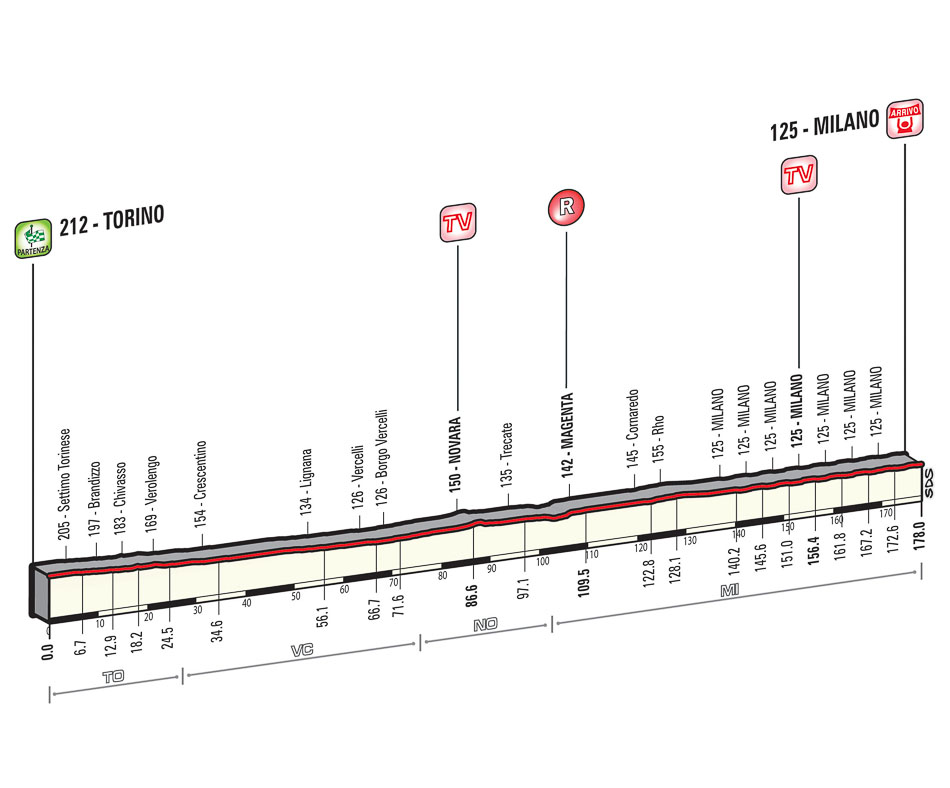
Here it is, the final day of the race, a flat one for the fast men of the peloton, who’ll get another shot at glory. Starting from Torino, the 185-km long route rolls through the Po Valley along entirely flat roads, and reaches Milan, connecting the cities that served (Torino) and serve (Milan) as headquarters for the Gazzetta dello Sport throughout history. The stage course covers wide and mainly straight roads, with just a few city-centre crossings, with roundabouts, speed bumps and traffic islands being the main, “typical” obstacles.

The route arrives in Milano through Pero and the Expo site, and it enters the final circuit, to be covered seven times, and finishing in Corso Sempione. The circuit is 5350-m long and stretches along wide, well-paved avenues around the Vigorelli velodrome and the Fiera Milano City fairground. It features eight bends and four half-bends, and it crosses a tram-line twice (vertically). The home straight is 1-kilometer long, on 8,5-m wide asphalt road.

First in the red jersey classification, with a 17-point advantage over Sacha Modolo, Giacomo Nizzolo can cap it off in style, by taking not only the jersey, but also the stage victory, his first in a Grand Tour. But it won’t be easy for the 26-year-old, as Sacha Modolo and Elia Viviani will be in the mix at Milan, where also Luka Mezgec will try to go out with a bang, just as he did in 2014, when he scored a big victory in Trieste.

The Corsa Rosa returns to Milan for the last stage three years after Marco Pinotti took the victory in the time trial that run over the cities streets, while Ryder Hesjedal became the first Canadian winner of a Grand Tour. Last time the Giro d’Italia finished here with a stage in line, Alessandro Petacchi finished first, but was subsequently disqualified and the victory went to Argentina’s Maximiliano Richeze.

2015 Giro d’Italia – Stage 20 Preview

T15_MadonnaDC_2_alt

What happened on stage 19

It was a mammoth day, won in the end by Fabio Aru, the best young rider in the race, who surged clear from the pink jersey group with around seven kilometers to go and catched Ryder Hesjedal, before leaving the 2012 champion behind and ploughing on to the finish line on Cervinia. The 24-year old scored his fourth Grand Tour victory and climbed to second in the overall classification, 38 seconds clear of Mikel Landa, his Astana teammate, who came in the same group as Alberto Contador. The Spaniard from Tinkoff-Saxo retained the maglia rosa, who now he’ll wear for the 21st day in his career, with just two stages left until the end.

What comes now

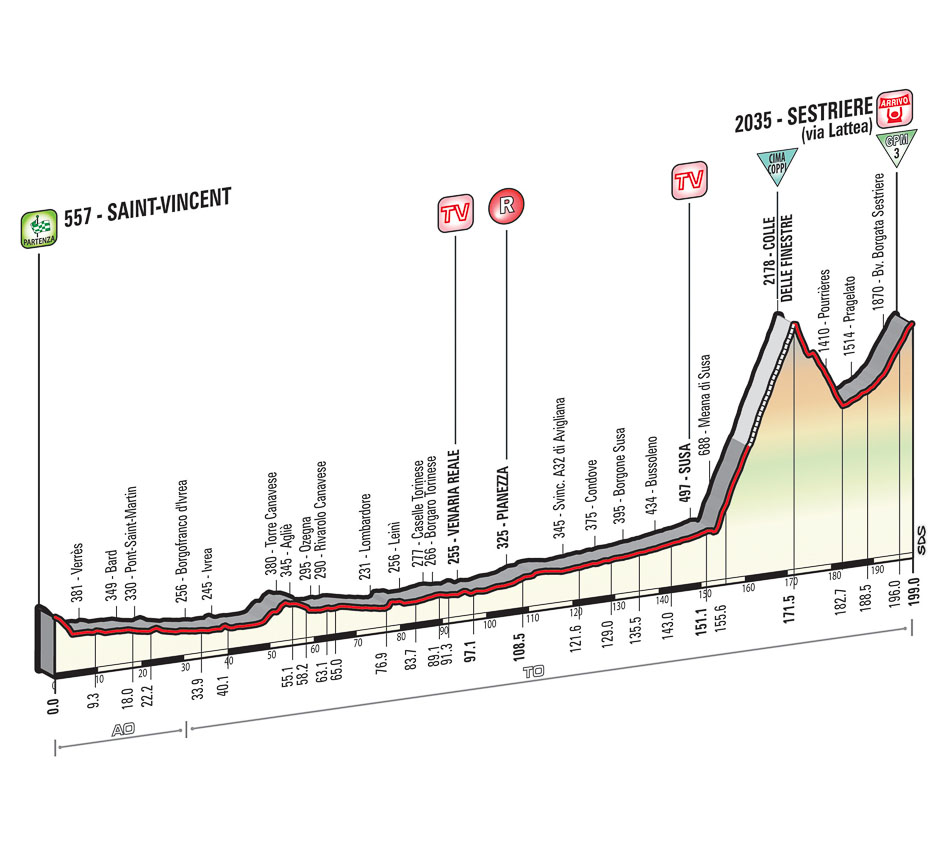
This high mountain stage (Saint-Vincent-Sestriere, 199 kilometers) features the last summit finish of this year’s Giro. The first 150 kilometers run across the whole upper Po Valley, and serve as warm up towards the Colle delle Finestre climb. The route rolls through the Canavese area via Ivrea and Rivarolo Canavese, it rolls past Venaria Reale and reaches the Susa Valley, before hitting Colle delle Finestre, which is Cima Coppi (the title given to the highest peak in the Giro d’Italia) in 2015. Colle delle Finestre has an elevation of 2178 meters and was already climbed (with its non-asphalted sector) in 2005 and in 2011. The winner of the stage featuring the Cima Coppi will be awarded the “Trofeo Torriani”, in memory of the legendary race director, who reigned between 1949 and 1993.

Colle delle Finestre (18,5 kilometers) climb features a steady 9,2% gradient, from foot to summit (with just a short spurt in Meana di Susa with a maximum 14% slope). The road is paved over the first 9 kilometers, while the remaining 9 kilometers run on dirt road, up to the summit. The first part of the ascent features as many as 29 hairpin turns in less than 4 kilometers (totalling 45 hairpins up to the crest). In the first part (up to Pian dell’Alpe), the descent is technical, narrow and not protected.

As the stage course goes back to ss. 23, the climb of Sestriere (9,2 kilometers, average gradient 5,4%) ramps up again, with affordable slopes, up to the finish. The last kilometers run along the ss. 23, with wide and well-paved roadway, with just a small roundabout 500 meters from the finish. The 400-m long home straight is on 6.5-m wide asphalt road.

Mikel Landa lies third in the overall standings, but he’ll look to climb back to second at Sestriere, where it all depends on the strategy of Astana and Fabio Aru’s legs, who seems to be going better and is very motivated to finish one place higher than he did last year. Landa can’t attack his teammate – whose resurgence could continue on Saturday – so his best hope is an acceleration of Alberto Contador, whom he can follow without being too concerned about Aru, in case the Italian has another bad moment.

Mikel Nieve, Ryder Hesjedal, Rigoberto Uran and Steven Kruijswijk can also be contenders, but for this they need a status quo among the main favorites, which isn’t very likely. Kruijswijk will also want to win the mountains classification, but it won’t be an easy task for the LottoNL-Jumbo, as Movistar can play two cards for this, Beñat Intxausti and Giovanni Visconti, who wears the blue jersey after Cervinia.

Sestriere will host a Giro d’Italia finish for the seventh time, and for the first time since 2011. Previous winners here are Eduardo Chozas (1991), Miguel Indurain (1993), Pascal Richard (1994), Jan Hruska (2000), Jose Rujano (2005) and Vasil Kiryienka (2011). The most famous winner is Indurain, but the most spectacular stage was the one of 2005, when Paolo Savoldelli, Gilberto Simoni, Jose Rujano and Danilo Di Luca where the protagonists of one of the best fights the race has ever witnessed.

2015 Giro d’Italia – Stage 19 Preview

T15_MadonnaDC_2_alt

What happened on stage 18

Philippe Gilbert became the first Belgian rider since Roger De Vlaeminck, in 1979, to take multiple stage wins in one edition of the Giro d’Italia, after attacking from the breakaway and soloing to the win in Verbania. On the Monte Ologno – the only climb of the day – Alberto Contador went clear after getting notice that Mikel Landa was involved in a crash and was two minutes behind. The Basque rider took back more than one minute, but once he returned to the Fabio Aru group he stopped, as another attack meant that his teammate would have risked losing the third place to Movistar’s Andrey Amador. As a result, Contador increased the gap in the general classification, more than five minutes being at the moment behind him and his Astana rival.

What comes now

This queen-stage (Gravelona Toce-Cervinia, 236 kilometers) throughout the Alps features a total difference in altitude of approximately 4800 meters, that is covered almost entirely over the last 100 kilometers, with three subsequent climbs, measuring up to almost 20 kilometers each. The route winds its long journey around the Alpine foothills through the districts of Borgomanero and Biella, and then it enters the Aosta Valley, where the last 150 kilometers of the day will roll out. The stage course tackles the St. Barthélemy ascent (16,5 kilometers at a 6,7% gradient), St. Pantaléon (16,5 kilometers at a 7,2% gradient) and, eventually, it ramps up the Cervinia climb (19,2 kilometers at a 5% gradient).

The last kilometers run entirely uphill. The route rises with the steepest slope just before, and while crossing, the town of Valtournenche. The climb starts to level out gently three kilometers before the finish. With less than 2000 meters remaining to go, the average gradient is 1,4%. The 450-m long home straight, on 7-m wide asphalt road, has a 4% gradient. Over the last six kilometers, the stage course features two well-lighted tunnels.

The headline of this stage should be the duel between Alberto Contador and Mikel Landa. The 32-year-old Spaniard is still in the hunt for his first ever Giro d’Italia stage and the Cervinia stage will provide him with the second-to-last opportunity to reach this goal, while his fellow countryman will hope to take his third victory at the race and increase his value for the upcoming transfer period, when many World Tour teams will be ready to fight for his signature.

Steven Kruijswijk and Ryder Hesjedal – who have hit top form in the last week of the Corsa Rosa – are two other strong contenders for the win, with the Dutchman being also interested in the blue jersey, which he wants to take home. If an escape will succeed, then look for cyclists like Franco Pellizotti, Carlos Betancur, Stefano Pirazzi, Igor Anton, Darwin Atapuma, Mikel Nieve and Rigoberto Uran, who all hope to get something from the race.

Cervinia will be a stage finish for the fourth time in 98 runnings of the Giro d’Italia, and will return to the race three years after witnessing an historic moment, the first Costa Rican victory in a Grand Tour. In 2012, from a breakaway that got a big gap at the start of the day, Andrey Amador outsprinted Jan Barta and scored his biggest win to date.


Navigare în articole