Cafe Roubaix

Despre ciclismul de azi şi cel de altădată

Stuart O’Grady, guest of the week at Cafe Roubaix

April 15th 2007. Dust is flying everywhere and the peloton is experiencing one of the hottest days in the history of Paris-Roubaix. A huge breakaway, of 32 riders, gets a gap in the 105th edition of the “Hell of the North”. It’s still early in the race, with around 240 kilometers to go, so the group doesn’t pose a real threat to the big favorites. After the Arenberg Forest, the escapees have a five-minute lead, which isn’t much, but somehow, the peloton misjudges the move and so, with around 25 kilometers left of the race, the riders at the front start realizing they have a real chance at winning the race.

That’s the moment when one of the cyclists decides to attack before the Bourghelles cobbled sector and powers away from his opponents, who don’t respond. He looks strong and the gap grows to more than a minute with just ten kilometers left until the finish, so he gives it all and keeps the chasers at bay. When he reaches the Roubaix velodrome, he’s up for the lap of honor, because nothing can change anymore. Under the eyes of the people gathered there, history is being written, as Stuart O’Grady becomes the first non-European cyclist to win the “Queen of the Classics”.

The Australian is already a Tour de France stage winner and world and Olympic gold medalist on the track, but this victory is one of the biggest of his career, after a great performance that leaves him speechless. Eight years after this moment and retired in the meantime, Stuart O’Grady anxiously awaits the start of the 113th edition of “Hell of the North” – this time in front of the TV.

It’s the race he loves and which gave his career a totally new dimension, so when contacted by Cafe Roubaix, he didn’t hesitate to preview it and have his say on the contenders.

– Mister O’Grady, what’s your take on the Tour of Flanders?

I thought Flanders was a great race to watch. Without Tom Boonen and Fabian Cancellara, the race was as wide open as it has been in ten years. Every team director would’ve changed their tactics to be much more aggressive, and many more riders would’ve started the race believing they could win. Sky put 100% faith in Geraint Thomas to win, but they probably did too much work, and then when it became crucial, Thomas had no more teammates. Eventually, the strongest and smartest rider won.

– Were you expecting such a strong ride from Alexander Kristoff?

Yes, absolutely. After he won three stages and the GC in the Three Days of De Panne, he proved his form was incredible. He has the power. He has a great team, probably the strongest in the world at the moment, and he is full of confidence.

– Did something surprised you in the tactics of his rivals?

If anything, they were too aggressive and made too many silly small attacks. Big attacks win bike races. They needed to isolate Kristoff, and make much more solid attacks. Once a “sprinter” smells the finish , there is no way they will drop him.

– Is Alexander Kristoff the new Classics star of the peloton?

It’s hard to say. Without the main two riders, I cannot say that. He is the best at the moment, he’s certainly making the best of the situation.

– Many consider him the top favorite for Paris-Roubaix, although he said he prefers the climbs of Flanders to the cobbled stretches of Roubaix. What do you think?

Etixx, Sky and BMC have to be a lot smarter than they were last week. They cannot take him within 25 kilometers from the finish. I did not have him as my favorite, but after seeing his ride, I must say he is definitely sure of a podium if he keeps going like this.

– Who can be his biggest rivals for the win?

I have Zdenek Stybar as my favorite, Niki Terpstra second and Alexander Kristoff third. Why? Because I think Etixx will ride a lot smarter. They have more riders capable of going a long way from the finish: Vandenbergh, Terpstra, Stybar. But watch out for Luca Paolini. He is not the strongest, but he’s very cunning. Also Thomas should be up there again, and how good would it be if Wiggins won solo? That would be my dream for the race! But if Wiggins wants to win, he has to hang in there until 30-25 kilometers to go, wait for the other teams to panic and chase, then counter attack and go solo. Wouldn’t that be a great way to see off your road career?

– Do you see Sep Vanmarcke capable of redemption after a lackluster display last Sunday?

Vanmarcke races with his heart on his sleeve. This can be good and bad! I definitely think he is capable of winning, but his team isn’t the strongest and he has to remain calm and keep his cool, something he is yet to do. He needs some more experience. He will win Flanders and maybe Roubaix in the future.

– Another contender who disappointed was Peter Sagan, again in the finale, just like in E3 Harelbeke. What do you think is happening to him?

Sagan is obviously under the strain of a not very good team environment. When there is trouble in the water, the boat never sails smoothly. With Tinkov firing Bjarne Riis, there would be a lot of stress and tension around the team. This feeds down through the staff and onto the riders. There’s nothing you can do about it. He has just signed a very big contract for three years, so automatically he doesn’t have that same “killer” instinct that he had the last few years.

– There are 27 sectors of paves, three of which have 5 stars. The last of these is Carrefour de l’Arbre, of which the organizers said it’s going to be rougher than in the past. Can you please describe this sector?

Every sector is difficult, but the Carrefour is extremely difficult because it comes so late in the race, your body is wrecked already, your hands numb, every muscle in your body is aching. Now it’s up to your mind over your body. It’s a long sector with many sharp cobbled sections and very rough edges. It all hurts!

– The forecast for Sunday says it will be sunny and dusty. What kind of race do you expect?

I like sunny and dusty. Rain is a complete catastrophe. When it’s wet it is hardly a bike race anymore. It’s too much to chance and ridiculously dangerous. Dry and dusty makes for a better race.

– Many riders will come at the start with the win in their mind, but only one will get his hands on the trophy. What does it mean for a cyclist to stand in the center of the Roubaix velodrome and raise the cobblestone trophy?

To be honest, there are maybe ten guys who can actually win Paris-Roubaix. There are many that “dream”, but with the first stroke of bad luck will be looking at making that their excuse. Just to finish the race is a massive achievement. To lift the rock is the best moment a cyclist can ever wish for. Greater than a World Championships, it is the best feeling a cyclist can hope for. That and the Olympic Gold or winning a Tour de France, these are the moments everyone dreams for, but only a lucky few make it happen.

Paris-Roubaix 1983: victorie incredibilă pentru Hennie Kuiper

Un olandez, Jan Raas, era deţinătorul trofeului în Paris-Roubaix acum 32 de ani, însă ciclistul echipei TI-Raleigh a fost nevoit să abandoneze înainte de jumătatea cursei, din cauza unor probleme de sănătate, dar şi a formei fizice sub aşteptări la acea vreme. A fost cel mai interesant eveniment din prima parte, una lipsită de acţiune, exceptând evadarea formată devreme, în care se aflau nu mai puţin de 20 de rutieri.

Apoi, înainte de intrarea în Pădurea Arenberg, Francesco Moser a atacat şi doar trei oameni (între care şi Gilbert Duclos-Lassalle) au putut să îl urmeze pe triplul câştigător din Paris-Roubaix. Imediat, în urma acestuia s-a dat alarma şi un grup format din Hennie Kuiper, Marc Madiot, Paul Sherwen şi Stephen Roche a plecat după italian. Ultimii doi au căzut, în timp ce Kuiper şi Madiot au evitat în ultima clipă capcanele, au tras tare şi au făcut joncţiunea.

Parcă supărat pe venirea acestora, Moser a continuat să impună un ritm înfiorător, pentru a îi obosi pe ceilalţi. Rutierul echipei GIS a fost foarte aproape să scape de un adversar, când Kuiper a căzut pe o porţiune cu piatră cubică. Fără să fie afectat de acest incident, olandezul s-a ridicat, a accelerat uimitor şi i-a ajuns pe cei din faţă, pentru ca apoi să mai cadă o dată. Nici acest incident nu l-a descurajat pe campionul mondial din 1975, care a avut nevoie de doar doi kilometri pentru a-l ajunge pe un Moser de-a dreptul uluit.

Apoi, cu aproximativ 20 de kilometri înainte de sosire, Kuiper a decis să atace pe o porţiune cu pavate şi nimeni nu s-a luat după el. De fapt, oamenii din urma lui sperau ca Francesco Moser – cunoscut pentru aptitudinile sale de contratimpist – să fie din nou cel care să îi aducă lângă ciclistul grupării Aernoudt Meubelen, însă peninsularul nu mai avea forţe după imensul efort depus până atunci.

Până ca adversarii să se dumirească, Kuiper a dezvoltat un avans de aproape două minute şi se pregătea să devină doar al patrulea batav din istorie învingător în Paris-Roubaix, după Peter Post (1964), Jan Janssen (1967) şi Jan Raas (1982). Soarta, însă, a vrut ca acesta să aibă parte de o cursă pe care să o ţină minte pentru totdeauna. Astfel, cu numai şase kilometri rămaşi până la velodrom, când Kuiper se afla din nou pe piatră cubică, la Hem, a decis să meargă pe marginea drumului, pentru a evita un eventual pericol.

A fost o idee neinspirată, deoarece campionul olimpic din 1972 a spart după ce a trecut pe o porţiune neasfaltată. Disperarea l-a cuprins pe Kuiper, dar şi pe mecanicul acestuia, venit în grabă să repare problema, fără succes. Secundele treceau, iar salvarea a venit, până la urmă, de la managerul echipei, care i-a adus rutierului său o altă bicicletă, l-a împins aproape o sută de metri, până s-a terminat sectorul de pavate, iar acesta a putut continua cursa.

A fost ultimul obstacol aflat în calea lui Hennie Kuiper, iar batavul a ajuns singur pe velodromul din Roubaix, unde a avut timp suficient pentru a-şi savura succesul, venit la a 11-a participare în “Infernul Nordului”. În urma lui, la un minut şi 15 secunde diferenţă, au sosit Moser şi Duclos-Lassalle, cu francezul pe locul al doilea, după ce l-a învins la sprint pe italian, care s-a clasat pentru ultima oară în carieră pe podiumul cursei sale favorite.

Who is Tiesj Benoot?

When the Tour of Flanders was over, not all the journalists who were attending the race rushed to take an interview to Alexander Kristoff, the winner of the 99th edition. The Belgians, left without a top contender for this year’s race after Tom Boonen’s injury, were more interested in getting a reaction from Tiesj Benoot. And why not, considering that Lotto-Soudal’s rider (just 21 years and 25 days at the start of the race) wrote a little piece of history, by becoming the best placed neo-pro in the last 41 years of Flanders, as well as the youngest rider since 1973 to finish in the top 10 of De Ronde.

As it often happened with many cyclists, Benoot didn’t discover the sport immediately, his first passion being football, which he played for five years, until he was 11. A goalkeeper (same position as Greg Van Avermaet, to whom he compares when it comes down to the skills he has), was at some point scouted by KAA Ghent, but the Belgian team eventually decided to back off, once the young Tiesj switched his focus to cycling, although his parents didn’t agree with this.

When he was just 15, he scored his first important result – 3rd at the Provincial Championship Oost-Vlaanderen, in the Novices race – but had to wait until 2012 before nabbing the first victory in the Junior ranks, which came in stage two of the International Junioren Radrundfahrt Oberösterreich, ahead of Matej Mohoric, as well as finishing second in the GC. Just a couple of months later, he took another win, this time in the prestigious Keizer der Juniores, and the feeder team of Lotto-Belisol noticed his potential and signed him for the 2013 season.

Under Kurt Van de Wouwer’s tutelage, he took three wins, the biggest of these being the overall classification at the Tour de Moselle, but most important, he made some significant improvements and emerged as one of the most versatile young riders in the U23 races, smooth on the cobbles and with a great punch on the short climbs. If there’s any need for some proof, then it’s enough to look at the outstanding results he has had in 2014: 3rd in the Tour of Flanders, 3rd in the Ronde de l’Isard d’Ariège GC, 4th at the World Championships, 5th in Liège-Bastogne-Liège and 5th in Flèche Ardennaise.

But Tiesj Benoot didn’t stop here and went on to mix it with the pros, finishing 8th in Binche-Chimay-Binche and 16th in Paris-Tours, where he pulled for Jens Debusschere. These placings came while racing as a stagiaire for Lotto-Belisol, and the team was so impressed by his display that it came up with a two-year contract. Benoot – who studies economic at the Ghent University, but is allowed to skip classes – needed only a couple of weeks once the new season kicked-off in order to underline his potential, with the one-day races providing him the opportunity to shine: 4th in Le Samyn, 3rd in Handzame Classic, and 6th in both Ronde Van Zeeland and Dwars door Vlaanderen.

Then, last Sunday, in the Tour of Flanders, he launched a late and surprising attack, with about 2,5 km to go, that netted him 5th place, just 36 seconds behind the winner, after a 264 km-long battle of attrition. The Belgian press was extatic after this result and dubbed him “the new Museeuw”. But they’re wrong, because he’s the first Tiesj Benoot and has every chance of becoming a cycling legend in the following decade, as almost every one-day race is within his reach.


Rider of the week

Two weeks ago, Alexander Kristoff was left disappointed after missing on a second consecutive win in Milan-Sanremo, despite the fact that Luca Paolini came up with an excellent lead-out in the finale and he looked to be strongest sprinter. Then, at both E3 Harelbeke and Gent-Wevelgem he didn’t get to fight for the victory, but made up for that a couple of days later, when he won the GC as well as three stages in De Panne, in what was one of the most impressive performances seen this year.

That display made him one of the top favorites for the Tour of Flanders, although many were wondering if can keep his rhythm and fresh legs for one of the toughest tests of the season. After playing it cool for about 240 kilometers, the 27-year-old rider made his move as soon as Niki Terpstra had attacked after the Kruisberg climb. Coming into the Dutchman’s wheel, Kristoff worked with him and did some strong pulls at the front, in order to keep the gap growing before the Oude Kwaremont and Paterberg.

Everyone was waiting for Terpstra to accelerate on one of these hills, but it didn’t happen, maybe because Etixx-Quick Step’s cyclist just didn’t have the legs or because he felt that his effort would net help dispatch Kristoff. Then, in the last five kilometers, when there was a gap of 28 seconds between the two of them and the chasers (Peter Sagan and Greg Van Avermaet), the Paris-Roubaix champion decided not to help his opponent anymore, being aware that the Katusha rider will outsprint him at the finish.

Having no other option, Alexander Kristoff stayed at the front and did all the work, ensuring they will keep a gap that was becoming slimmer and slimmer. With 200 meters to go, Terpstra launched his sprint, but had no chance against a powerful Kristoff, who was calm all the way, knowing he has the upper hand. This landed him the victory and assured the Katusha leader a place in the history books, as the first ever Norwegian winner of the Tour of Flanders, after a race in which he did everything: got the corner kick, sent the ball into the box and scored a goal with his head.

Now he’ll take a rest and then prepare for Paris-Roubaix, the last Spring Monument which suits him. Although he doesn’t have a great record there, with three abandons, a 9th and a 57rd place in five starts, is difficult to bet against him for the “Hell of the North”.

Vuelta al Pais Vasco Stats

Historical stats

– The first edition took place in 1924 and Francis Pélissier was the winner of what has known by the name of Gran Premio Excelsior

– The race was mentioned in Ernest Hemingway’s acclaimed novel “The Sun Also Rises”

– At first, the leader’s jersey was red, it then changed to blue, and finally to yellow

– Jose Antonio Gonzalez Linares is the rider with the most GC victories, 4, between 1972 and 1978

– Spain leads the nations standings, with 23 triumphs, followed by Italy (7) and Switzerland (5)

– Sean Kelly and Domingo Perurena share the record for the most stage wins, 11

– Laurent Jalabert has the most days spent in the leader’s jersey, 12

– Only riders from outside of Europe to take the overall are Chris Horner (U.S.A.) and Nairo Quintana (Colombia)

– No world champion has ever won the Vuelta al Pais Vasco

– Biggest winning margin between the first and second was recorded in 1924, when Francis finished 14:54 ahead of his brother, Henri

– 1989 saw the smallest gap, just one second between Stephen Roche and Federico Etxabe

– The first Tour de France champion to win the Vuelta al Pais Vasco was Jacques Anquetil, in 1969; the last one was Alberto Contador, in 2009

– Youngest ever winner is Jose Luis Laguia (22 years in 1982); oldest winner is Chris Horner (38 years in 2010)

2015 stats

– 19 teams (17 World Tour, 2 Pro Continental) will make-up the startlist of the 55th edition

– 4 of these teams haven’t scored a victory in 2015: Caja Rural, Cofidis, FDJ and LottoNL-Jumbo

– Two former winners will line-up in Bilbao (from where the race will depart): Nairo Quintana and Samuel Sanchez

– The peloton of the 2015 race has won a combined total of 7 Monuments, 2 Grand Tours, 6 World Titles and more than 60 Grand Tour stages

– Spain has the most cyclists at the start, 26, five more than France

– Matej Mohoric, the former Junior and U23 World Champion, is the youngest rider in the Vuelta al Pais Vasco (20 years), oldest one is Sky’s Xabier Zandio (38 years)

– The climb to the Santuario de Arrate will be a stage finish for the seventh year in a row

2015 Tour of Flanders Preview

Turul Flandrei 2015

Created in 1913 by Karel Van Wijnendaele, a sports journalist who was inspired by Henri Desgrange, the Tour of Flanders was a Belgian affair for many years, not only because it was scheduled on the same day as Milan-Sanremo, but also because the weather and the difficult course weren’t appealing to the foreign riders. So it’s not surprise that the first 31 editions had only one non-Belgian winner, Switzerland’s Henri Suter, at that time one of the finest Classics cyclists.

As the years went by, De Ronde grew in prestige and became one of the most important one-day races of the calendar, entering the famous club of the so-called Monuments, alongside Milan-Sanremo, Paris-Roubaix, Liège–Bastogne–Liège and the Giro di Lombardia. As expected, some of the biggest riders came at the start and made Flanders one of their prime goals, but only few achieved it, because the Belgian race is one of the toughest out there and to win it you have to be strong, intelligent, but also lucky.

Looking over the history book of the Tour of Flanders, we can find the names of Briek Schotte, Fiorenzo Magni, Rik Van Looy, Eddy Merckx, Johan Museeuw, Tom Boonen and Fabian Cancellara among the ones of the winners, but there’s also room for Hugo Koblet, Francesco Moser, Sean Kelly and Phil Anderson, some of the most famous cyclists who failed to take the victory they were dreaming of. This year, around 200 riders will line-up at the start, but only one of them will get to join the likes of Merckx, Boonen and Cancellara, while the others will think of the missed opportunity and count the days until the following edition.

The course                 

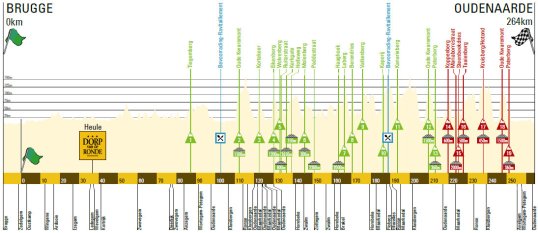
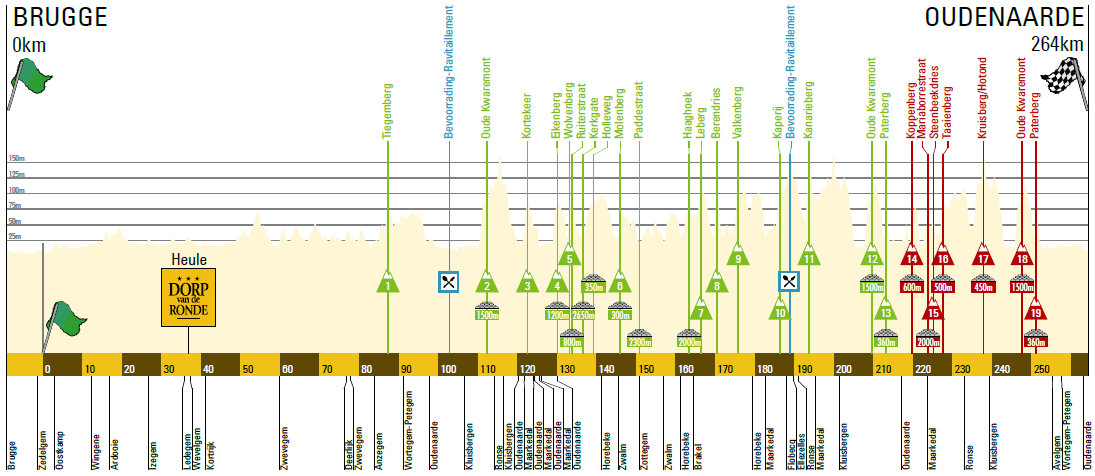
For a couple of years now, the organizers seem to be playing a game in which they are trying to make the route harder and harder. This is why the 99th edition (264,2 kilometers) will have two extra climbs, a decision which was criticized by team managers and riders alike in the past months. Basically, they are accusing the race officials that in their desire to get a more spectacular and exciting course all they will really get is a boring race, giving the fact that the riders will not be willing to attack early on such a difficult parcourse.

As was the case in the past, the peloton will line-up in Brugge, the birth city of Guydo Reysbrouck, one of the best Classics riders of the ‘60s, with victories in Amstel Gold Race, Züri-Metzgete and Paris-Tours (three times). From there, the cyclists will have a long section of flat roads for more than 80 kilometers, before hitting the first hill of the day, Tiegemberg (which was the last climb in E3 Harelbeke). 30 kilometers later, the riders will face the legendary Oude Kwaremont for the first time (2200 meters, 4% average gradient, 11% maximum gradient) – a climb which starts with asphalt before switching to cobbles – and the real fun will begin from that point on.

Kortekeer, Eikenberg and Wolvenberg will follow, before a series of three flat cobbled sectors: Ruiterstraat, Kerkgate and Holleweg. The sixth hill of the race will be Molenberg (463 meters, 7% average gradient, 14,2 maximum gradient), where Fabian Cancellara and Tom Boonen left behind all the other riders at the 2010 edition, although back then Molenberg came much later in the day, with 40 kilometers to go.

The cobbled stretches of Paddestraat and Haaghoek are next, leading the way for Leberg, Berendries (which is returning on the route after a two-year absence), Valkenberg, Kaperij and Kanarieberg, which will all make for a very hectic race and trim the peloton before the second passage on the Oude Kwaremont. There will be no rest for the bunch, as Paterberg (360 meters, 12,9% average gradient, 20,3% maximum gradient) – one of the toughest hellingen out there – is tackled immediately, in less than four kilometers.

Number 14th on the menu will be the infamous Koppenberg (600 meters, 11,6% average gradient, 22% maximum gradient), and the battle for position will be a fierce one, because every meter counts on this hill. Koppenberg isn’t the oldest of the climbs, as it was brought into the attention of the organizers around 40 years ago, by Hubert Hoffman, but is the toughest one. Some riders call it “the torture chamber”, because of its steep gradient and irregular cobblestones, and it remains famous after the 1987 edition, when Jesper Skibby crashed and a race car drove over his bike. That incident led to Koppenberg being taken out from the parcourse until 2003, before being dropped again in 2007. After the Oudenaarde municipality underwent some significative repairs to the climb, it returned in 2008 and since then it’s making the riders’ life a living hell.

The ones left behind won’t have a chance of coming back in the pack, as Steenbeekdries, Taaianberg (which can give ideas to some cyclists) and Kruisberg/Hotond will follow up shortly, making for a race of attrition, before the final circuit on the Oude Kwaremont and Paterberg. From the top of the Paterberg there are just 13 kilometers left on big, flat roads, so if a rider is at the front he’ll need a lot of power to stay there, especially with the forecasted headwind, as the ones coming from behind will put up a strong chase. Then, in Oudenaarde, where the race finishes for the fourth year in a row, we will find out the name of the cyclist who will get his place in history for winning the 99th edition of the race.

Expert’s view

George Hincapie: “17 climbs was probably enough. The race is one of the hardest in the world anyway, I think the addition of the two hills may just make the earlier climbs perhaps a bit slower. On the other hand, although I feel like the old course perhaps had more historical significance, the new course is more spectator friendly. The fans can almost get a stadium like atmosphere going on the circuit. Either way, the race is going to be brutally hard and the favorites have to attack at some point, otherwise they may risk getting beaten by a sprinter at the end.”

The favorites

Both Tom Boonen and Fabian Cancellara – each a three-time winner of Flanders – are sidelined after getting injured in March (the Belgian in Paris-Nice, the Swiss rider in E3 Harelbeke), and even though the race certainly has lost some of its glamour and shining because of their absence, it will serve as a preview for the time when the two of them won’t be in the peloton anymore and an heir will be expected to rise and take the vacant throne as king of the cobbles.

Expert’s view

George Hincapie: “The absence of those guys will affect some of the tactics. I would envision a lot more Trek guys trying to get in breakaways rather then just staying in the bunch. Tom’s team already has a few guys that can win the race, so their tactics may not change too much. They will want to control the race from the start.”

Etixx-Quick Step has the numbers on Sunday, and Patrick Lefevere’s boys are expected to control the race and play it in their favour with an aggressive approach. On the other hand, having numerical superiority doesn’t mean you’ll win, which we could see last year: the Belgian team placed six riders in the top 60, while Trek had just one, but it was the winner. On the other hand, it’s important to mention that Etixx-Quick Step also has one of the main favorites: Zdenek Stybar. The Czech winner of Strade Bianche comes at the start in a great shape and with a high morale, and is expected to get that breakthrough win in a Monument on a course that really suits him.

On the other hand, it won’t be all about Stybar, because Etixx-Quick Step also counts on Niki Terpstra, the Paris-Roubaix champion. Terpstra was discrete in E3 Harelbeke, but showed that he is slowly getting into shape two days later, at Gent-Wevelgem, where he finished second. He will be another important weapon for the team, just as will be both Guillaume Van Keirsbulck and Stijn Vanderbergh. Basically, all that Etixx-Quick Step has to do is to play its cards right and find the mojo of the past, when it made the decisive move at a moment when the others were less expecting it.

After his great Flandrian week-end (in which he won E3 Harelbeke and came third in Gent-Wevelgem), Geraint Thomas is considered by pundits and fans alike the premium contender for the victory, in a race which previously saw just one British winner (Tom Simpson, 1961). Sky’s leaders isn’t just one of the strongest men in the pack, but also one of the most intelligent, sensing when it’s the proper moment to launch the attack, as shown last Friday. Having finished eight at last year’s Flanders and supported by a solid team, Thomas has the consistency and confidence that it takes to win this time. Question is: after his recent feats, will he also have the freedom?

With Tom Boonen out of the race, Belgium’s biggest hopes in a win lie in Sep Vanmarcke, a rider who many are seeing as the rightful heir of “Tommeke” in the Monuments. Ever since the end of last season, the 26-year-old rider of LottoNL-Jumbo is training and making plans for the Tour of Flanders and Paris-Roubaix, 2015 being his big opportunity to lose the “nearly-man” tag that he is carrying on his back for some time now. Vanmarcke is in an excellent condition, knows how to position himself on the climbs, is strong, but lacks a fast finish, so he has to attack on one of the bergs and make sure he’ll leave everyone else behind.

Second last year, Greg Van Avermaet will lead BMC, with one goal in mind: get the win that has eluded him in the past seasons. Unfortunately for Van Avermaet, he crashed at E3 Harelbeke and finished Gent-Wevelgem just in 36th position, but he is poised to shrug off the disappointment and put on an aggressive display in a race where he came three times in a row in the top 10. If Van Avermaet – who you can be sure that he’s willing to attack and shape the race – fails to rise to the expectations, then watch out for his teammate, Daniel Oss, who is very strong this Spring and has the advantage of being an outsider, and thus surprising the big guns of a peloton in a moment they’ll look at each other.

In The Three Days of De Panne, Alexander Kristoff has had one of the most impressive rides of the season, winning three stages in a row, as well as the general classification, after an incredible individual time trial, which helped him cap a perfect race. Kristoff isn’t as explosive as some of his rivals, but he can hang on in there and even if he gets distanced on the Paterberg, he can come back on the flat roads that go to Oudenaarde, where he’ll be a favorite in a sprint. The stats aren’t in his favor though, as only two riders who won the GC in De Panne went on to conquer Flanders (Peter Van Pettegem – 1999 and Alessandro Ballan – 2007).

It’s important not to forget that Katusha also has an important joker, Luca Paolini, who can go at the front, in order to give his teammate a free ride in the bunch. But Paolini, who added Gent-Wevelgem to his palmares last Sunday after a wonderful and gutsy ride, is very dangerous and can be an useful decoy, so if the bunch ignores him in case of a late tactical move, then he can ride solo to the finish and become the oldest winner of the race.

Another very good sprinter who can climb is Giant-Alpecin’s John Degenkolb. Supported by the likes of Koen De Kort and Zico Waeytens, the 26-year-old German wants to take his revenge after being hit by bad luck in E3 Harelbeke and Gent-Wevelgem, and thus continue his excellent run in the Monuments, after winning Milan-Sanremo. Degenkolb isn’t in the same league as the very best on the bergs, but depending on how the race pans out (especially if there’s a bad weather that will not favor the attackers), he can hope for a sprint finish, where he’ll start as one of the big favorites.

Despite his poor form and run, which netted him just a victory in 2015 (stage six of Tirreno-Adriatico), Peter Sagan remains a contender for the second Monument of the season, that could turn out to be a pivotal race for his first year with Russian outfit Tinkoff-Saxo. Things didn’t go smooth in the semi-classics for the Slovak, who missed the win in both E3 Harelbeke and Gent-Wevelgem, and looks to be overtrained, while also having a mental block. On the other hand, maybe this uncharacteristic role of underdog will help Sagan surprise his rivals and nab the win in Oudenaarde, where he came second two years ago.

Stijn Devolder provided an emphatic display in the 39th edition of the Three Days of De Panne, although he came second in the overall standings, and he is looking very sharp before De Ronde. The result he got mid-week was a massive boost of confidence for the rider who took back-to-back victories in Flanders more than half a decade ago and Devolder will be keen to have one more shot at glory on home turf, especially as he s the roads better then 90% of the peloton. Clearly, the 35-year-old Belgian won’t be a top contender, but he remains a very dangerous man and if the others will underestimate him and he gets a gap, then there’s a big chance they won’t see him again until the finish.

Expert’s view

George Hincapie: “Greg Van Avermaet is one of the big favorites. He has had an incredible form in the first part of the season. He’s been quiet the last few races due to crashes and bad luck, but his form and motivation to make up for last year’s second place will be there on Sunday. Peter Sagan will be looking for a change. He’s been there in all the big ones this year, but hasn’t pulled one off. We all know he is capable. Zdenek Stybar is also very strong, a complete contender with perhaps the deepest team. He will be among the protagonists at the end. Gerraint Thomas is in the form of his life and it was very impressive watching him over the last few months. If his team plays it right, he can for sure win. Kristoff was there in the second group last year, and he seems to be even stronger this year. You don’t want to bring him to the finish line with the favorites. If he is there, he will be hard to beat.”

Other cyclists who will go for a strong result on Sunday are Bjorn Leukemans (who, despite of his age, is always approaching the Classics in great form and is capable of a top 10), Lars Boom, Filippo Pozzato – who hopes to end Italy’s drought of 2360 days in the Monuments – Edward Theuns, Sylvain Chavanel, Heinrich Haussler, Jelle Wallays and Jurgen Roelandts, who had a strong and impressive ride in Gent-Wevelgem, where he showed he is on the right track for the Tour of Flanders, a race he finished third in 2013.

Expert’s view

George Hincapie: “Daniel Oss is my outsider. He is showing great form. If he is in the breakaway, the team will want him to conserve energy in case Greg comes back to them. He could take advantage of that at the end if they don’t get caught.”

Race stats

– Six riders share the record for the most wins: Tom Boonen, Achiel Buysse, Fabian Cancellara, Eric Leman, Fiorenzo Magni and Johan Museeuw

– Belgium leads in the nations standings, with no less than 68 victories

– Five of the 98 editions didn’t have a Belgian cyclist on the podium: 1951, 1961, 1981, 1997 and 2001

– Briek Schotte and Johan Museeuw share the record for the most podiums (wins included): 8

– The legendary Briek Schotte is also the rider with the most starts (20 in a row) and the most finishes (16), but the latter is shared with Frederic Guesdon

– Youngest ever winner is Rik Van Steenbergen, 19 years and 206 days (1944); oldest one is Andrei Tchmil, 37 years and 71 days (2000)

– 1920 – when Jules Van Hevel took the win – saw the lowest average speed: 26,105 km/h

– Highest average speed – 43,576 km/h – was recorded in 2001

– The first edition was also the longest one: 324 kilometers

– Only once throughout history De Ronde had less than 200 kilometers, in 1941 (198 de kilometers), when Achiel Buysse won the race for the second time

– Last rider to nab the victory while wearing the rainbow jersey was Tom Boonen (2006)

– 1919 saw the largest winning margin: 14 minutes between Henri Van Lerberghe and Lucien Buysee

– The only cyclist to take three wins in a row is Fiorenzo Magni (1949-1951)

– Five riders have won the amateur, as well as the pro Tour of Flanders: Roger Decock, Edward Sels, Eric Vanderaerden, Edwig van Hooydonck and Nick Nuyens

– Gent is the only city that has hosted both the start and the finish of the race

– Brugge is a start city since 1998, the year of Museeuw’s third and final win

– 1944 was the last year in which the Tour of Flanders ended on the velodrome

– In 1984, only Phil Anderson and Jan Raas got to the top of the Koppenberg without walking, the main reason being the deteriorating state of the cobbles

– Trek’s Stijn Devolder is the only former winner (2008, 2009) who will be at the start of this year’s edition

– John Degenkolb can become the second rider, after Eddy Merckx (1969 and 1975), to win Milan-Sanremo and the Tour of Flanders in the same season

– The youngest cyclist in the race is Quentin Jauregui (20 years); the oldest one is Matteo Tosatto (40 years)

– 18 neo-pros will make their debut in a Monument: Simone Antonini, Jesper Asselman, Tiesj Benoot, Sven Erik Bystrøm, Magnus Cort, Dylan Groenewegen, Quentin Jauregui, Tim Kerkhof, Oliver Naesen, Alberto Nardin, Luka Pibernik, Marc Sarreau, Kristoffer Skjerping, Ivar Slik, Sjoerd van Ginneken, Brian van Goethem, Bert Van Lerberghe, Ruben Zepuntke


Turul Flandrei 1919: o cursă de poveste

În urmă cu aproape un secol, pe când avea 28 de ani, Henri Van Lerberghe s-a prezentat la startul celei de-a treia ediţii a Turului Flandrei fără bicicletă, motiv pentru care a fost nevoit să împrumute una de la cumnatul unui alt ciclist, Jules Messelis. În 1919, primul an în care Turul Flandrei s-a desfăşurat în sensul invers acelor de ceasornic, belgianul nu era un rutier important, în palmaresul său mai figurând doar o victorie, la ediţia din 1913 a Turului Franţei, când a terminat primul la Bayonne, după o etapă în lungime de 379 de kilometri.

Cu toate acestea, Van Lerberghe a venit plin de încredere în Flandra, spunându-le celorlalţi concurenţi că îi va chinui teribil în cursă, afirmaţie care a fost primită cu amuzament. Pentru a le demonstra tuturor că nu glumeşte, el a atacat cu 120 de kilometri înainte de final, când caravana trecea prin Ichtegem, localitatea în care era născut Jules Vanhevel, unul dintre favoriţii la victorie. Fără să îl ia în serios, cicliştii din pluton l-au lăsat să se desprindă, convinşi fiind că nu va rezista prea mult, mai ales că vântul lateral bătea cu putere.

Spre surprinderea tuturor, Henri Van Lerbeghe a dezvoltat un avans impresionant, de peste jumătate de oră, moment în care ceilalţi rutieri au început să se organizeze pentru a-l prinde. În acest timp, în faţă, belgianul din Lichtervelde a trecut prin câteva aventuri unice, care i-au creat un loc special în istoria Turului Flandrei. Mai întâi, el l-a întâlnit pe un ajutor al lui Marcel Buysse, care îl aştepta pe acesta cu mâncare. După mai multe minute de discuţii, l-a asigurat că Buysse a abandonat şi l-a convins să îi dea săculeţul cu mâncare ce îi era destinat câştigătorului din urmă cu cinci ani, atunci când Van Lerbeghe a terminat pe poziţia a doua.

Apoi, cu forţe proaspete după ce a luat masa, ciclistul originar din Lichtervelde a continuat cursa, iar la un moment dat a ajuns la o cale ferată, blocată de un marfar ce era staţionat de ceva vreme acolo. Fără să stea prea mult pe gânduri, şi-a luat bicicleta în spate, a urcat într-unul dintre vagoane şi a coborât pe partea cealaltă, spre uluirea fanilor aflaţi pe marginea drumului.

Practic, după ce a trecut şi de acest obstacol, cel poreclit “Ritte” era virtual câştigător. Ştiind şi el acest lucru, a hotărât să intre într-un bar amplasat cu puţin înainte de velodromul plin de oameni care aşteptau noul învingător. Fără să îi pese de acest lucru, Henri Van Lerbeghe a comandat o bere blondă şi a început să îşi savureze succesul. Fermecat de gustul excelent, venit la fix după peste 200 de kilometri de cursă, “Ritte” a mai cerut un rând, iar apoi încă unul. După a treia bere a apărut antrenorul său, care îl căuta disperat, pentru a-l convinge să termine cursa.

Până la urmă, Van Lerbeghe a acceptat să urce pe bicicletă şi a ajuns pe velodrom, acolo unde trebuia să facă turul de onoare. A reuşit acest lucru, dar fără să pedaleze, ci mergând alături de bicicletă, după ce şi-a dat seama că are probleme în a-şi menţine echilibrul. În timpul turului, el le-a strigat spectatorilor să plece acasă şi să revină peste câteva ore, deoarece adversarii lui se aflau la mai mult de jumătate de zi în urma sa. Nu a fost chiar aşa, “doar” 14 minute separându-l de al doilea clasat, Lucien Buysse, fratele lui Marcel. Cu toate acestea, a rămas până astăzi cea mai mare diferenţă din istoria clasicei.

Conclusions after E3 Harelbeke and Gent-Wevelgem

Etixx-Quick Step has a tough life without Tom Boonen, the team resembling to a ship which lost its compass. The squad still has some very strong riders, with the likes of Niki Terpstra and Zdenek Stybar spearheading Etixx for the Tour of Flanders and Paris-Roubaix, but something just doesn’t click in the team whenever it comes to the one-day races. Add this to some dodgy decisions from the team car, and you have a big picture where the Belgian team is struggling to find its pace and tactics on the cobbles. Patrick Lefevere said he’s not worried at the moment and asked that the team be judged on April 12th. A fair request, but if his riders fail to put their mark on the Monuments, then 2015 will go down as one of the worst Spring seasons in the history of Etixx and it will take a great display in July for people to forget this.

The horrible weather shaped Sunday’s Gent-Wevelgem and made for one of the best Classics ever seen, a race of heroes and truly one for the ages. Only 39 riders managed to get to the end, and as Jean-Pierre Drucker put it, all would deserve a “Gent-Wevelgem Survivor” T-shirt. But not only Gent-Wevelgem put on a great show, with also E3 Harelbeke being a spectacular race, that had attacks, a crazy chase and a surprising outcome. The great racing we’ve had last week-end raises the bar for De Ronde, but also pinpoints to one thing: it’s very likely that the Tour of Flanders, in the absence of both Fabian Cancellara and Tom Boonen, will have a surprise winner, as was the case in Gent-Wevelgem, where nobody was expecting Luca Paolini to cross the line first.

Speaking of Luca Paolini, the Italian shined on a rainy day and showed in Gent-Wevelgem that age has nothing to do with guts and instinct. With just five kilometers to go, he attacked from the main group and soloed to the finish line, where he became the oldest winner of the race (38 years), thus breaking the record of the legendary Briek Schotte, which was standing from 1955. Just like two years ago, when he took the victory in Giro d’Italia’s stage seven to Marina di Ascea, Paolini put one hand on his hea and and one to his heart, underlining that cycling isn’t only about who was the strongest legs, but also about the ones who give it all and play it perfectly in order to succeed.

For years, Sky has struggled to match its stage racing dominance in the Classics. For a team used to winning big in events like the Tour of France, Paris-Nice, Tour de Romandie or Critérium du Dauphiné, the disappointment caused by the one-day races came as a hard pill to swallow. After five seasons with just two victories – both in Omloop Het Nieuwsblad – Sky reached a turning point in 2015 and it’s slowly transforming itself in one of the dominant teams for the Classics, thanks to Ian Stannard and Geraint Thomas (who’s in the best form of his career). So far, in four cobbled semi-classics, the British outfit took two wins and two podiums, and with Flanders and Roubaix knocking at the door, the morale is high and that big win the team is searching for is not a dream anymore.

Two big favorites for the Tour of Flanders and Paris-Roubaix came empty handed from E3 Harelbeke and Gent-Wevelgem: Sep Vanmarcke and Peter Sagan. After the injuries that have hit both Fabian Cancellara and Tom Boonen, the Belgian was hyped to take over the crown as the best pavé rider, but things didn’t go as planned for him, and Vanmarcke, all of the sudden, doesn’t look so strong as he was at the beginning of the Spring. The pressure also seems to add up, with the spotlight being on him for the Monuments, which means every moves he makes will be countered by others and he’ll have little space for pavé. When it comes to Sagan, the Slovak is a bit of an enigma. He should have won E3 Harelbeke easily, but he failed in a spectacular way, reminiscent of last year’s Strade Bianche. Hard to say if Sagan had a hunger-knock or is overtrained (a very plausible hypothesis), but one thing that’s certain is he’ll enter Flanders as an underdog and with many doubts.

Rider of the week

It has been a great week-end for Sky’s Geraint Thomas, who is enjoying his best ever Classics campaign. On Friday, the Welsh rider took an emphatic win in the 58th edition of E3 Harelbeke, after an impressive display all day long and a perfect timed attack with just 4 km to go. After going at the forefront on the legendary Oude Kwaremont, where he was quickly followed by Zdenek Stybar and Peter Sagan, Thomas was the main powerhouse of that group, his hard work being the reason for him and the other two cyclists staying at the front.

Knowing that he’s the weakest in a sprint, the 28-year-old attacked with just four kilometers left and dispatched Sagan – who popped and couldn’t follow – and Stybar, who waited too much before deciding to go after him. There was nothing more to do for the Czech, considering Geraint Thomas was rolling at around 50km/h in those last kilometers of the race as he swept into Harelbeke, where he became the first ever British cyclist to win the Belgian semi-classic.

After that victory, Thomas said that the result gave him the much need confidence for the rest of the Classics, and this was obvious two days later in Gent-Wevelgem, where he has the most powerful rider in the race, although this didn’t land him another win, but a third place, behind Luca Paolini and Niki Terpstra. The result was equally impressive, as Thomas survived a crash before getting at the front and taking the last place on the podium, which helped him climb to second in the World Tour standings.

Before E3 Harelbeke, people were talking of Ian Stannard and Bradley Wiggins as Sky’s main riders for the cobbled Classics, but Geraint Thomas’ huge results add a new dimension to the team’s plans for Flanders and Roubaix. Of course, Thomas will now have to ride with the favorite tag on his back, but at the rate he’s going, barring crashes or misfortunes, next Sunday he has a huge chance of becoming Britain’s second De Ronde winner, after Tom Simpson, in 1961.

Gent-Wevelgem Stats

Historical stats:

– The first edition of the race took place in September 1934 and was won by Gustave Van Bell

– In 1935, the organizers decided to include the Flemish Ardennes on the course

– Starting with 1945, the race became open for pro cyclists, up until that point having at the start only amateurs

– Five riders share the record for the most victories (3): Tom Boonen, Mario Cipollini, Eddy Merckx, Robert Van Eenaeme and Rik Van Looy

– Belgium leads the nations standings, with 48 wins, way ahead of Italy (6) and Netherlands (5)

– The only rider to win the race while wearing the rainbow jersey was Rik Van Looy, in 1962

– The record for the longest time span – 10 years – between the first and last victory belongs to Mario Cipollini: 1992-2002

– Belgium’s Johan Museeuw has the most podiums – 4 – without winning the race

– Only winners from outside of Europe are Djamolidine Abdoujaparov (Uzbekistan) and George Hincapie (U.S.A.)

– Biggest time gap between first and second was recorded in 1950, when Briek Schotte came home 2:46 ahead of Albert Decin

– Youngest ever winner is André Declerck (19 years in 1939), while the oldest one is Briek Schotte (35 years in 1955)

– Same Briek Schotte is the first cyclist to win the race witk Kemmelberg on the course (1955)

2015 stats:

– The 2015 race will have 239 km and 9 climbs: Casselberg, Casselberg, Catsberg, Baneberg, Kemmelberg, Monteberg, Baneberg, Kemmelberg and Monteberg

– Five former winners will be at the start of the 77th edition: Edvald Boasson Hagen, Marcus Burghardt, John Degenkolb, Bernhard Eisel and Peter Sagan

– As expected, Belgium will line-up the most cyclists, 34

– Jakub Mareczko is the youngest rider to take part in the 2015 race: 20 years

– His teammate from Southeast, Alessandro Petacchi, is the oldest one: 41 years

– The peloton of this this year’s race has won a combined total of 8 Monuments and more than 150 Grand Tour stages

Navigare în articole