Cafe Roubaix

Despre ciclismul de azi şi cel de altădată

2015 Giro d’Italia – Stage 11 Preview
T15_MadonnaDC_2_alt

What happened on Stage 10

It should have been an easy day for the sprinters, but the breakaway of five gave the peloton the slip, going all the way to the line, where Bardiani’s Nicola Boem took the biggest win of his career. But the main story of the day developed once Richie Porte punctured in the closing kilometers of the stage to Forli and couldn’t return to the peloton despite chasing hard, eventually finishing 47 seconds behind Alberto Contador and Fabio Aru, his rivals to the pink jersey. It wasn’t the end of this, as the UCI jury found out that the Australian got a front wheel from his countryman Simon Clarke, which is against the rules, as Clarke is riding for another team. As a consequence, Porte was docked two minutes and now lies in 12th place, 3:09 off Alberto Contador.

What comes now

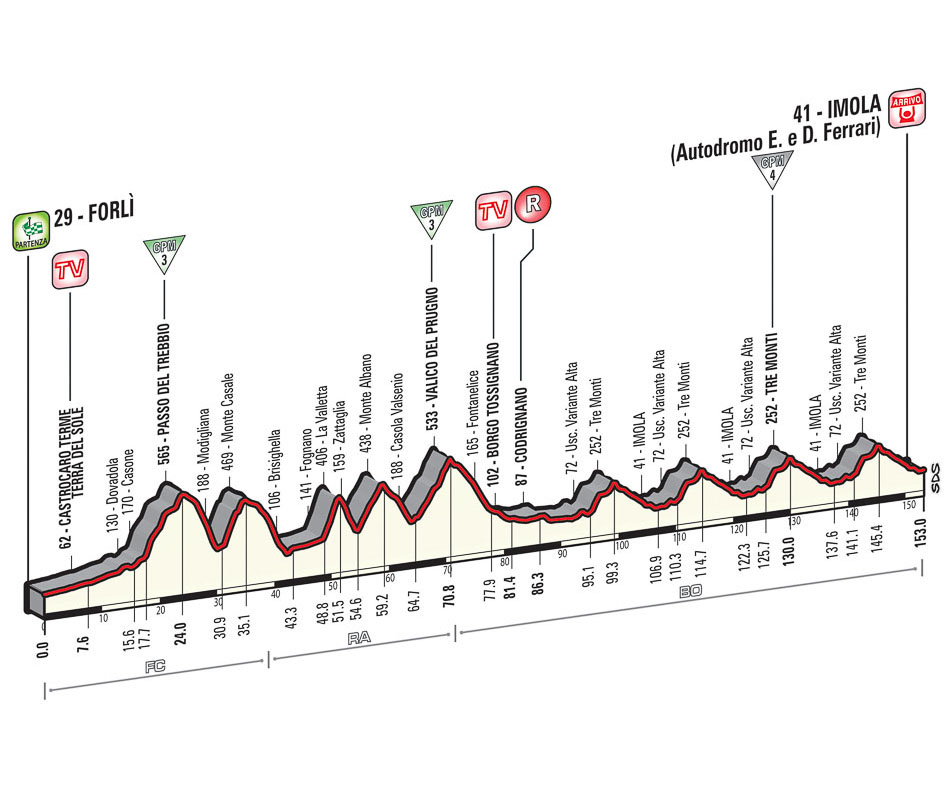
Stage 11 (Forli-Imola, 153 kilometers) is short, yet quite challenging, marked by five short but hard-going climbs before entering the final circuit (the Tre Monti circuit), to be covered three times. The route takes in these climbs one after another, and never flattens out: Trebbio, Monte Casale, La Valletta, Monte Albano and Valico del Prugno. Then it reaches the Imola race track and enters the final circuit, at the exit point of the “Variante Alta” chicane.

The final 15,4-km long circuit is raced partly on the Imola race track, and partly outside it. From the finish line (on the pit straight), the route covers around 3,5 kilometers of the track, up to the “Variante Alta”. Here, the stage course leaves the race track, takes the climb leading to Tre Monti (4 kilometers, 5% average gradient), then descends onto quite wide and well-paved roads until the last kilometers, that leads to the entry point of the Rivazza turn, around 850 meters before the finish. The route features one last bend 650 meters from the finish, and a long, slightly bent home straight on an 8-m wide, perfectly level tarmac surface.

Even before the rest day, Michael Matthews made clear that he’s interested in winning this stage, and the former U23 world champion will start as one of the main contenders, although his chances depend largely on the thoughts of the GC teams, who can blow the race to pieces as they’ve done more than once last week. Another cyclist who marked this stage is Fabio Felline, but the Italian’s problem is that he isn’t the fastest in the pack in case it ends up in a sprint, although truth being told, he defeated Matthews in a Vuelta al Pais Vasco stage.

Enrico Battaglin and Davide Formolo also have their eyes on this day, and the same goes for Diego Ulissi, the winner of the Fiuggi stage. 2012 world champion Philippe Gilbert can be in the mix as well, and he has two options: to go into the attack and to wait for the sprints, where Francesco Gavazzi, Juan Jose Lobato and Grega Bole can also feature. Other candidates, but from a break, are Gianfranco Zilioli, Stefan Küng, Simon Geschke (who will try to gain more points in the mountains classification), Maciej Paterski, Luis Leon Sanchez and Adam Hansen.

The peloton will get to finish for the third time in Imola, the city most noted as the home of the Autodromo Enzo e Dino Ferrari. At the previous visit, in 1992, Italy’s Roberto Pagnin took his only stage victory in the Corsa Rosa. The finishing circuit of Wednesday is identical with the one used for the 1968 World Championships, when Vittorio Adorni won the rainbow jersey.

2015 Giro d’Italia – Stage 10 Preview

T15_MadonnaDC_2_alt

What happened on stage 9

Paolo Tiralongo took his third victory in the Giro d’Italia, this time from a breakaway, becoming the oldest ever cyclist to win a stage at the race (37 years and 313 days). Once again, Rigoberto Uran lost time when Fabio Aru attacked, only Alberto Contador and Richie Porte being capable of responding. In the last 250 meters, Aru launched a sprint and gaped the Spaniard for one second. Contador remained in the pink jersey, with a three-second advantage over Aru.

What comes now

On Thursday, the bunch will line-up in Civitanova Marche, ready for a 200-km long stage which finishes in Forli, the town of Ercole Baldini, one of the finest time trialist ever seen, winner of the Giro d’Italia and the World Championships in 1958. The day is entirely flat and covers almost the whole of the Adriatica coastal road. The route unfolds along wide and largely straight roads for 100 kilometers, with just a brief detour to climb up Montedi Gabicce from the Pesaro slope. The following 60 kilometers run straight along the ss. 9 Via Emilia, through Santarcangelo di Romagna, Cesena and Forlimpopoli, leading to the finish in Forli.

The last kilometers past Forlimpopoli run along straight roads, with roundabouts and traffic dividers being the main obstacles typically found in urban areas. Approximately two kilometers before the finish, there is a 1,500-m setts paved sector, with a bend 1,100 meters from the finish, in Piazza Saffi, and a bottle neck 800 meters from the finish. The route features one last bend 500 meters before the end of the stage. The home straight is on level, 7-m wide asphalt road.

The weather will be excellent, with warm temperatures, but there’s still a risk of crosswinds. Giving how aggressive the GC teams were in the first week, it wouldn’t be surprising to see them coming at the front yet again, trying to create some damages and distance their rivals. Otherwise, this is going to be a day for the sprinters, and the technical finale should play into the advantage of Sacha Modolo, a rider who loves it when things become messy in the last kilometer. Another strong contender will be André Greipel, who’s keen to take the red jersey back from the shoulders of Elia Viviani. Of course, Sky’s sprinter will also feature there, as will Matteo Pelucchi and Giacomo Nizzolo, who is still in the hunt for his first Grand Tour victory.

Forli will host a Giro d’Italia finish for the ninth time, first visit here taking place in 1925, when Costante Girardengo was victorious. More recently, in 2006, Robbie McEwen was first – ahead of Olaf Pollack and Tomas Vaitkus – and became the only non-European cyclist to win in the capital of the Forli-Cesena province.

2015 Giro d’Italia – First week stats

– Orica-GreenEdge is the first team since Del Tongo (1985-1986) to win successive team time trial stages in the Giro d’Italia

– Simon Gerrans and Simon Clarke became the 7th, respectively the 8th Australian cyclist to wear the pink jersey

– Davide Formolo, Jan Polanc and Elia Viviani all scored their maiden victory in a Grand Tour

– André Greipel claimed his 13th career win in a Grand Tour and climbed to fifth in an all-time list of German stage winners in Grand Tours, behind Erik Zabel (20), Rudi Altig (18) and Marcel Wüst (14)

– Paolo Tiralongo became the oldest ever winner of a Giro d’Italia stage: 37 years and 313 days

– Seven of the 22 teams have nabbed a victory: Astana, Cannondale-Garmin, Lampre-Merida, Lotto-Soudal, Movistar, Orica-GreenEdge and Sky

– Alberto Contador has 12 days in the pink jersey and lies in third among the active riders, after Ivan Basso and Vincenzo Nibali, both with 19 days

– Simon Geschke is the first German cyclist to lead the mountains classification in the last four years

– Home riders have had an excellent week, winning four stages so far, taking Italy’s tally to 1241 victories in the race

– The first eight stages in line were won by eight different cyclists

– Ten riders have abandoned the race thus far, Etixx-Quick Step and Nippo-Vini Fantini being the only teams with two cyclists out of the race

Rider of the week

On paper, Peter Sagan didn’t come to the Tour of California with aspirations for the overall classification, as people were talking before the start of a fight between Sergio Henao, Robert Gesink, Ben Hermans and Joe Dombrowski for the glory. At best, he was hunting for a stage victory, but everyone knew it wasn’t going to be an easy task, as Mark Cavendish was the top contender in the flat days. Eventually, after finishing three times in a row second, the Slovak champion found the way to a victory, in Avila Beach, taking advantage of the fact that he knew the last 200 meters to perfection, unlike his opponents.

Later in the week, Santa Clarita saw him finishing again on the podium, before the redesigned course for the individual time trial had Sagan powering to a commanding win, which surprised people because of the huge gaps he created on the 10,6 km-long parcours. Still, the most impressive ride of the Tinkoff-Saxo leader came on Mount Baldy, a tough Hors Categorie ascent, where he was expected to make way for the climbers and lose minutes, thus getting out of contention.

But Sagan – who changed his cadence on the mountains this season – decided to have a defensive approach on Baldy and keep his energy once the attacks began to come, pacing himself all the time, helped by the fact he always had visual contact with some cyclists ahead. Inspite of the fast tempo and riders attacking all over the place, the Slovak kept his composure and came home just 47 seconds behind stage winner Julian Alaphilippe, losing the yellow jersey for just two seconds, with one day remaining until the end of the race.

Then, on Sunday, in what was one of the most thrilling finales a stage race has seen in the past seasons, a finale truly worthy of a big budged Hollywood movie, Peter Sagan finished third at Pasadena for just 1/100 of a second in front of Tyler Farrar, but only after the organizers checked the photo-finish, prolonging his and Julian Alaphilippe’s agony. By winning the US race (for a mere three seconds) and showing he’s more than just a sprinter/Classics-type of rider, the 25-year-old relaunched his season, discovered a new dimension of himself and now has every reason to look with optimism towards the Tour de France, where he can be once again of the top protagonists.

2015 Giro d’Italia – Stage 9 Preview

T15_MadonnaDC_2_alt

What happened in stage 8

It was another another nervous day at the race, which started fast and led to more than 100 riders losing contact with the main group early on. Then, at the first intermediate sprint – won by Eduard Grosu – Alberto Contador came second and this allowed him to double the advantage he has in front of Fabio Aru in the general classification. On the last climb of the stage, Beñat Intxausti won from the break, while Aru and Richie Porte attacked Contador, hoping to distance him, but with no luck, as he responded each time.

What comes now

Benevento-San Giorgio del Sannio (215 kilometers) is a very wavy stage, with a total difference in altitude just under 4000 metres. The first rough part of the route rolls across the Benevento area, hitting Pietrelcina, Benevento and Atripalda. Here the course enters the Irpinia region, with a long and easy-to-ride climb up Monte Termino (20 kilometers, 4,2% average gradient), which is preceding the more challenging Colle Molella (9,5 kilometers, with slopes of 6,3%) ascent.

The route then follows the constant undulations that lead through Lioni, Sant’Angelo dei Lombardi and Castelvetere sul Calore, up to 20 kilometers from the finish, where the harsh Passo Serra climb (3,6 kilometers, 8% average gradient) will lead to the final kilometres of the stage. The road surface is worn out and narrow at points over some sectors. The Passo Serra climb has a really demanding central sector, reaching double-digit gradients. A short, brisk descent follows, up to five kilometers from the finish. Another short climb and a stretch on city roads precede the 600-m long home straight, with a 3% gradient.

On paper, this is an excellent course for the break to succeed, so look to such riders as Simon Clarke, Maciej Patersi, Enrico Battaglin, Philippe Gilbert, Adam Hansen, Ryder Hesjedal and Gianfranco Zilioli ready to take their chance. On the other hand, if everything will be kept under control by the peloton, then Orica-GreenEdge has the opportunity to take the victory, with Michael Matthews or Simon Gerrans, the only requirement for the Australian team being to pick the right man for this, unlike what they did in the Fiuggi stage.

Fabio Felline nabbed a second place in the race, but is in the hunt for that win that can save his team’s Corsa Rosa, which means he’ll be determined to give it everything in the finale. Giovanni Visconti – who lies in 7th place overall – has what it takes to go for the victory and the Italian is prepared to do utmost in order to reach his goal, but he should be with his eyes on fellow countryman Diego Ulissi, who recently proved that he came back to the top.

The Giro d’Italia has visited San Giorgio del Sanio just once in its history, at the 1987 edition. Back then, Paolo Rosola – one of the finest sprinters of the decade – came first, followed by Guido Bontempi and Stefano Allocchio.

2015 Giro d’Italia – Stage 8 Preview

T15_MadonnaDC_2_alt

What happened on stage 7

Diego Ulissi won his fourth stage in the Corsa Rosa, this being his first victory since serving a nine-month ban for salbutamol. After the longest day (264 kilometers) of this year’s Giro d’Italia, the Italian rider of Lampre-Merida outpowered Juan Jose Lobato and Simon Gerrans in Fiuggi, before being overwhelmed by huge emotions thanks to this liberating win.

What comes now

Stage 8, which takes the pack from Fiuggi to Campitello Matese (186 kilometers), is marked by the lengthy climbs of the two KOMs: Forca d’Acero (26 kilometers with a 5% slope) and Campitello Matese (13 kilometers, with ramps of 6,9%). After the start, the route hits Alatri, Veroli and Sora on largely flat roads. This is where the long Forca d’Acero climb begins, leading first to Abruzzo, and then fast to Molise. Along and easy-to-ride descent leads to Isernia along the new ss. 17 express way, which features a series of tunnels. Past Isernia, a further stretch on wide and slightly hilly road leads to the Campitello Matese climb.

The final ascent is 13 kilometers in length, and after the first deceptive false-flat drag, the route gets to the town of San Massimo with gradients of approximately 10%, then it takes the road leading to the finish (large, well-surfaced and with wide hairpin bends extending up to one kilometer from the finish). Starting from the last kilometer, the road descends slightly up to 250 meters from the finish. Here the road levels out on the home straight, on 6.5-m wide asphalt road.

Fabio Aru and Richie Porte will try to test Alberto Contador, who has a subluxation of his shoulder after crashing in stage six, so you can bet on the fact that the two of them will attack at some point, the main question being if Contador can hang on. It will also be interesting to see how the Spaniard’s team will react on the last ascent, considering it was below-par in some key moments of the race so far, after a very powerful start to the race. Besides these three, other cyclists to watch out for are Rigoberto Uran, Darwin Atapuma and Giovanni Visconti, who’s had a very impressive first week.

Campitello Matese is going to host a Giro d’Italia stage for just the seventh time in history. Most recent visit here was recorded in 2002, when Gilberto Simon won ahead of Francesco Casagrande and Franco Pellizotti, while 37-year-old Jens Heppner kept the pink jersey he was helding since stage seven.

Ivan Basso: “I’m prepared to help Contador win the Giro”

A two-time winner of the Giro d’Italia – a race in which he took six stage victories – Ivan Basso is one of the most successful Italian riders of the past 15 years. A pro since 1999, he raced for such teams as Fassa Bortolo, CSC and Liquigas, before eventually signing a two-year contract with Tinkoff-Saxo, where he joined Alberto Contador in his quest of making the legendary Giro-Le Tour double. Although he was the leader of his previous squads, Basso isn’t unsettled by the fact that he’ll now ride as a “lieutenant” of Contador in the mountains, where he’s expected to play a key role.

A couple of days ago, I had the opportunity to interview the 37-year-old cyclist from Gallarate and find out more about his preparation for the Corsa Rosa, his best memories from here and Alberto Contador’s chances of winning the Trofeo Senza Fine for the second time, after the 2008 edition.

– Ivan, the 2015 Giro d’Italia is your 9th since turning pro. Were you nervous before the start?

The days before the start are always nervous, because I feel like I’m ready to make my debut here. I’m focused to be at 110% and give everything, both for my fans and my team.

– You’ve won the trophy twice: in 2006 and 2010. Which of these triumphs you rate higher?

It’s impossible to pick one of the two trophies, considering the wins came în different moments of my career. What’s for sure is that each time I was very touched and the feelings I had are unforgettable.

– And how about your stage wins? Which is the most important one?

One of the victories of which I can say it means a lot for me is the one I got on the Monte Zoncolan, back in 2010, because it came on one of the most toughest climbs in Europe, and also because it came after a very difficult moment of my career. It was a turning point, one which I’ll never forget.

– How did you prepare for the race?

I trained for this race like I was going for the general classification, in order to be ready to give everything in case the team needs me. I’m very motivated for the Giro and fueled by the support I get from my fans. I also went on the recon of a couple of stages, like the Valdobbiadene individual time trial (ed. – stage 14) and the Monte Ologno, which comes in stage 18. Anyway, in a Grand Tour you always have to stay alert, because anything can happen, even on a flat stage.

– Is Alberto Contador the main favorite for the overall victory?

Alberto is prepared, both from a physical and a mental point of view. He didn’t leave anything to chance, he studied the profile of the race and wants to win this race. Il Giro is one of his biggest goals of the season. He has a huge talent, he’s very determined and ready to give everything in order to succeed, and I’m happy to help a champion of his tally

– Who is his biggest rival: Richie Porte, Fabio Aru or Rigoberto Uran?

All three are powerful rivals and we have to watch out for them in every single moment. They proved themselves in the past and they can be dangerous in many of the stages. It would be a huge mistake to underestimate them.

2015 Giro d’Italia – Stage 7 Preview

T15_MadonnaDC_2_alt

What happened on stage 6

After a textbook lead-out of Greg Henderson, André Greipel claimed his 13th career win in a Grand Tour, and his third in the Giro, following the ones of 2008 and 2010. By doing this, he climbed to fifth in an all-time list of German stage winners in Grand Tours, behind Erik Zabel (20), Rudi Altig (18) and Marcel Wüst (14). It was a crazy finish, which led to a crash festival because of a spectator trying to take a photo. Many riders hit the ground, including Rigoberto Uran (with no serious consequences), Nippo-Vini Fantini’s Daniele Colli – who fractured his arm – and race leader Alberto Contador, who ended up with a dislocated left shoulder, and although he is in pain, will try to be at the start of Friday’s stage.

What comes now

With a length of 264 kilometers, this is the longest stage of the 2015 Giro, and the longest in any edition of the Corsa Rosa of the last 15 years. Its profile features no really challenging points, but the final part of the route is quite wavy. The first 70 kilometers run along the Aurelia highway, the route then enters the Maremma region past Montalto di Castro. Rolling along gentle undulations, the route hits the towns of Tuscania and Vetralla, and skirts around the urban agglomeration of Rome.

The sole categorized climb of the day is set in Monterotondo (4th category, 2,5 kilometers, 5,1% average gradient), on top of a shorspurt. After rolling past Tivoli, through the hamlet of Ponte Lucano, the peloton will be confronted with the last 60 kilometers, wavier and more complicated, in terms of both course and profile, that lead to the finish in Fiuggi, along Via Prenestina.

After the town of Piglio, some 15 kilometers from the finish, a U-turn leads to a short descent (where the road is slightly narrower at points); from here, the stage course takes the new Via Anticolana. The last 10 kilometers run gently uphill. After crossing the Monte Porciano tunnel (672 meters – straight and slightly uphill), 5 kilometers from the finish, the route reaches Via Prenestina through large, well-paved roads, still climbing slightly. Upon entering urban Fiuggi, the road turns left, and climbs at a gradient of 2% up to the last kilometer, where the route becomes slightly steeper. The home straight is 350-m long, on 7-m wide asphalt road, with a gentle 3-4% gradient.

Having such a long stage and a testing finish will sure lead to a nice breakaway going ahead up the road, with the hope of giving the slip to the sprinters. If the cyclists that are at the front are caught, then attacks will come on the undulating roads to the finish, before the last climb. In case none of these goes to the end, Michael Matthews will become the main favorite for the win, the 24-year-old Australian having a big opportunity to take his second victory at this year’s edition, after the one in Sestri Levante.

Orica-GreenEdge can play at two heads, with Simon Gerrans attacking in the finale and paving the way for a sprint of Matthews if he gets caught. Philippe Gilbert is another rider who is very likely to go full gas in the last kilometers, same thing applying to Giovanni Visconti. On the other hand, if it will all play out at a sprint, besides Matthews, other cyclists who have a fair chance of nabbing the win are Fabio Felline, Enrico Battaglin, Grega Bole, Francesco Gavazzi and Juan Jose Lobato.

It will be for the ninth time that a Giro d’Italia stage will end in Fiuggi. At the previous visit, in 2011, Alessandro Petacchi was in a perfect position coming into the last 500 meters, but he launched his sprint to early and was overhauled by Francisco Ventoso, who took his first victory in the race. Back then, the top 10 consisted of a mix of sprinters and GC riders, with Danilo Di Luca and Michele Scarponi also fighting for a good place.

2015 Giro d’Italia – Stage 6 Preview

T15_MadonnaDC_2_alt

What happened on stage 5

For the second day in a row, the breakaway went all the way to the finish, where Jan Polanc won his first race. A 23-year-old who turned in pro in 2014, the Lampre-Merida cyclist became the second Slovenian to take a stage in this race, after Luka Mezgec. Behind him, Alberto Contador attacked from the peloton with four kilometers to go and only Richie Porte and Fabio Aru were able to follow him from the favorites group. The three launched an exciting sprint in the last 500 meters, with Aru finishing third and taking bonifications thanks to which he’s now just two seconds behind Contador, the new leader of the Giro d’Italia.

What comes now

On Thursday, the peloton will line-up at the start in Montecatini Terme, one of the towns that have hosted the 2013 UCI World Championships. This stage is almost entirely flat, except for a short, central sector where the categorized climb is set. The first 80 km roll along mainly level roads across the Pisa territory. Just past Saline di Volterra, the route reaches the Colline Metallifere and goes ahead, passing through Pomarance (KOM climb), Larderello and Castelnuovo Val di Cecina.

A final, level stretch leads to the finish, on largely straight roads.The last eight kilometers are on a perfectly flat road and feature only two bends, 2,7 and 2,3 kilometers from the finish, followed by a long, slightly bending stretch up to 1,000 meters from the finish, where the home straight begins, on 7,5-m wide asphalt road. 1,500 meters from the finish there is a speed bump that can be cleared following a straight trajectory. There, in the Castiglione della Pescaia – a town which makes its debut in the Giro d’Italia – the sprinters are expected to fight for victory.

André Greipel came to the Corsa Rosa with the goal of taking a win, and after failing to do it in Genova where he “didn’t read” the finale as he should have, the German rider of Lotto-Soudal has a big chance to make up for that in stage six, which totally suits him. On the other hand. Elia Viviani looks to be in a great shape, but the leader of the points classification will not be underestimated now, after his rivals made that mistake a couple of days ago.

Sacha Modolo will also be eager to bag a victory and make it two out of two for Lampre-Merida; for this, Modolo will count on the likes of Maximiliano Richeze and Roberto Ferrari, two cyclists that can prove very important in the last kilometers. Finally, Giacomo Nizzolo (who has had some health problems), Matteo Pelucchi and Moreno Hofland will be other sprinters hoping to cross the line first in Castiglione della Pescaia, but they’ll start as outsiders on Thursday, so a win of one of them will count as a semi-surprise.

Serghei Tvetcov: “I want to finish the Giro”

One of the two Romanians to ride the 98th Giro d’Italia, Serghei Tvetcov came at the start of the event with confidence, after blending in the pro peloton of the European scene during his first four months with Androni Giocattoli-Sidermec, the team for which he signed after having an impressive season in the UCI America Circuit in 2014. With the Italian outfit he got to ride some of the most important races of the calendar, and even scored a strong result in the Tour de San Luis individual time trial, where he came fourth.

Last week, before coming at the start of the Giro d’Italia – where he’s the only non-Italian cyclist of Androni – I got to talk to Serghei about his time so far with Gianni Savio’s squad and his goals for the Corsa Rosa, which marks his debut in a Grand Tour.

– Serghei, how were your first months with Androni Giocattoli-Sidermec?

They were amazing. The way the team is organized is really great and I got to do a lot of big races. I feel great with this group of people. The guys are nice, the sports directors are doing an excellent job, people are serious, but also know how to have fun. Of course, I need to gain a lot of experience in terms of racing, culture, nutrition and training, because every little detail counts, from your weight to your recovery and bike position. In my opinion, in Europe it’s impossible to have results if you have an extra 1-2 kg, you really can’t be at the top and can’t recover between races. Here you have to carefully choose in which events you are going to get a good result and in which just to train. So, coming back to the question, I think that this team really fits me and I can become a much stronger rider here, and for this reason I’m very glad that I decided to sign with Androni.

– What was the best racing experience up until this point of the season?

When it comes to one-day races, I must say Strade Bianche and Milan-Sanremo, especially as I want to do good in these races in the future. As for stage races, my prime pick is the Giro del Trentino, which has some great roads and views.

– Are you nervous before the Giro d’Italia, your first Grand Tour?

Actually, I’m not. I am pretty calm and I’m really looking forward to do the best I can for the team. A Grand Tour is a race that separates the boys from the real men.

– And how did you prepare for this?

I had a pretty busy racing schedule since January, because in my opinion, the best preparation is to race. Besides that, I focused on losing weight, while keeping my power.

– Did you get do a recon of some stages?

Yes, I had the chance to see the 18th stage (ed. – Melide-Verbania), but of course, in order for this to help me, I first need to get to the third week.

– What are your goals for the race?

My main goal is to finish the 21 stages, then to support our captain Franco Pellizotti and to learn, to get experience, which will help me in the future to get nice results. Besides that, I want to feature in some breakaways.

Navigare în articole