Cafe Roubaix

Despre ciclismul de azi şi cel de altădată

Joe Dombrowski: “I’m looking forward to the Vuelta”

Among the riders making their debut in the 70th edition of the Vuelta a España – the season’s third and final Grand Tour – there will be also Joe Dombrowski, who comes here after taking a breakthrough win at the Tour of Utah, where he put years of suffering behind and enjoyed his finest moment since turning pro. The 24-year-old will be one of the many Cannondale-Garmin cyclists hoping to shine and thus get a stage win, and although this is going to be his maiden three-week race and he starts as an outsider, Dombrowski shouldn’t be overlooked, as he can turn into one of the Vuelta’s revelations.

A couple of years ago, he was seen as the next big thing in cycling, after winning the prestigious Girobio and finishing in the top five at both the Tour of California (where he also was the best young rider) and the USA Pro Cycling Challenge, two events in which he outshined many pros. His impressive results led to a contract with Sky, but the two-year spell with the British outfit wasn’t a happy, but more a bleak one, due to many health problems which kept hampering him, problems whose main cause remained unknown for a long period of time, until a vascular specialist told him to undergo some tests, before finally discovering what was really troubling him: iliac endofibrosis – basically, a drop of blood flow in his iliac artery, which meant he was getting 50% less blood in his left leg than normal.

After having surgery at home, he took a long break before coming back on the bike and starting to work in order to gradually build his form. Eventually, at the end of the season, Joe changed teams, moving to Cannondale-Garmin, where he was looking forward to show that he can come back to the top. Making his debut for the US team in Argentina, at the Tour de San Luis, Joe Dombrowski finished in the top 10, which made him very confident ahead of his next goals, the Tour of California and the National Championships, two races in which he put on an impressive display, finishing fourth and second, respectively.

For that reason, and taking into account that his form was constantly on the rise, his stage win on Snowbird and overall classification victory in the Tour of Utah didn’t count as a surprise, but more as a confirmation of the fact he finally reached the much desired top level just weeks before the start of the Vuelta, where he comes very motivated to test himself and see what he can do in a three-week race.

A couple of days ago, while he was still at his home in Nice, I talked to Joe Dombrowski about the way his season went since pulling on the green and argyle of Cannondale-Garmin and the expectations he has ahead of his Grand Tour debut.

– Joe, what were your thoughts at the beginning of the season, after joining Cannondale-Garmin?

I was a good change for me and I’ve really enjoyed it so far. I feel really at home being in a US team and I think it’s a good environment for me, I feel comfortable and I like being among other Americans. Another important thing is that at Cannondale-Garmin I have more opportunities than I did with Sky. I want to develop into a GC rider, so I think that Cannondale-Garmin, at the moment, is the right option for me to do that, because I can go on some of the races and ride in support of Daniel Martin, Andrew Talansky and Ryder Hesjedal, while in some smaller races where they aren’t there I can be the leader of the team. It’s very important to have more opportunities for myself, than I did in the past.

– Looking behind at your two years with Sky, what conclusions can you draw?

It was a little bit difficult, because last year I had the injury and the operation on my iliac artery, and it was hurting my performance. Once the operation was done, it was almost three months before I was out training on the road again. So last season I didn’t raced so much. But no matter on what team you’re in, to have an injury like that means it’s not going to be a nice experience. Other than that, I learned a lot during my two years with Sky and got exposure by riding the big races, and I also got to live in Nice, where is my European home and where I feel comfortable. Maybe I didn’t score a lot of results and I was having a lot of setbacks because of the injury, but I wouldn’t say it was a negative experience.

– After these troubled seasons, how important was it for you to get a top 10 in your first race of the year, the Tour de San Luis?

I think it was good. It’s an early season race, and as a North American rider coming from the cold, and racing in the summer against South American cyclists who are in good shape, meant the race was a tough one. I wanted to see how I can go, because it was my first real test after having the operation and coming back after the injury. It was a good start for me and it gave me a lot of confidence, I felt I’m back in the game and I also had fun, which is very important for me. Cycling is a hard sport, it’s about suffering, but if you’re in an environment where you’re having fun, you really look forward to the racing.

– Not many riders say they’re having fun in the races.

For me this is what I’ve dreamed of doing and I don’t want to take for granted the fact that I’m basically getting to do what I dreamed of doing for a living. I don’t think there are many people – doing all kind of jobs – who can say that they are living their dream when at work. For me, that’s the case: I love riding my bike, I love racing, and I love everything about it – the training and focusing on being fit for the races, traveling all over the world and living in a foreign country. There are a lot of things that I’ve been really lucky to do. Of course, sometimes you get some crappy weather and you don’t have a great morale and don’t feel like getting out there and racing, but overall I love what I’m doing.

– After San Luis, you had a good run on home turf, in both the Tour of California and the National Championships. Did you see the glass half-full, or did they leave you with a bitter taste?

Concerning the Nationals, I’ve always thought about how cool it would be to wear the national champion jersey for a year. It’s just something really special to do that at some point in my career. Second was a good result for me in a race like that, giving that everybody went there wanting to win. It wasn’t a race for me initially, but for my teammates, as I really can’t sprint very well. Still, considering the way it played out, I got an opportunity in the end. I was a little bit disappointed to be runner-up, because I wanted to win and wear the jersey for a whole year. In the Tour of California, my ambition was to be on the podium, but I finished fourth, which I can say it still was a good result. Overall, I can be happy with that, considering that the year before I was in just a couple of races. Basically, California confirmed to me that I was on the way back.

– Did you felt like you kept improving between the Nationals and the Tour of Utah?

As you know, I came back to Europe, the plan being to ride for the general classification in the Tour de Suisse. I don’t know if it was because of the fact that I was tired as I began my season early, in San Luis, but I wasn’t very good in Suisse. So after that, I returned home to the US and didn’t touch my bike at all for some time. Basically, I took a vacation, went to see some friends and pressed the reset button, as I knew I’ll do the Vuelta at the end of the year. I wanted to make sure that I’ll come into the second half of the season really fresh. I haven’t trained so hard before the Tour of Utah, but I still prepared for the race, because I wanted to have a good GC. In the end, I kind of surprised myself in the Tour of Utah.

– But what were your thoughts before the start?

Obviously with the news in regard to Tom Danielson it was a shock, it’s not really what someone wants to hear at the start of the race, it’s a bit difficult, but I talked with the guys the night before the race after we heard what it happened and I said that we still have a race to do and that I think we can still win it, as well as takins some stages along the way. So we decided to think about the race, to focus on it and make the best out of it. We all did a great work and overcame a difficult situation.

– How much did it mean for you to win the race?

It was great. That’s my first ever victory as a professional, and winning the stage to Snowbird was special, as well as taking the yellow jersey and defending it the next day. It was awesome. This season was kind of a reset year and to have my first pro win was very nice and special.

– The Vuelta a España is up now on your schedule. Are you nervous about making your Grand Tour debut?

I’m pretty relaxed, actually. I know I haven’t raced in a three-week event, but I’m excited about it and I’m really looking forward to gaining experience. I still don’t know what my role is going to be, but I’m sure that it’s going to be a good experience. I’m in my third year as a professional and it’s very important to finally get to ride a Grand Tour. It would be a really big step to finish such a race.

– Besides this, what other goals do you have?

Well, I’ll have to see are the plans of the team, but especially in the third week – once the general classification is established and there are bigger time gaps – I could go in a breakaway on a mountain stage. If there’s no one dangerous there, there’s a good chance they’ll let it go, and once you’re there you don’t fight against Froome or Quintana, but against the other guys who are in the escape. If I’d get the opportunity to fight for a stage victory, then I would love to get one.

– What do you think of the course?

The Vuelta is always mountainous and has short and punchy climbs at the finish, which will be the case also this year. Then there’s the Andorra stage, with six major climbs. It’s going to be one of the hardest routes of the year, and looking at the startlist, it’s maybe the Grand Tour with the most depth in terms of Grand Tour stars: Froome, Nibali, Quintana, and the list goes on, it looks like everyone’s doing it. It’s going to be a very high level here.

– Did you pick your books for the Vuelta?

Yes, I did. I got a lot of suggestions on Twitter and I now have plenty of books to read during the three weeks of the race, one of the books being Richard Moore’s „The Bolt Supremacy”. Personally, I think that it’s very important to read a book in the evening, especially in a Grand Tour and any stage race, actually. You ride hard during the day and you need a nice way to relax. In my opinion, you have to put down your phone, your electronics, your computer, and just read a book before going to bed. It’s really great to go old school and read some books, and it’s something I like to do during the race. We need less smartphones, and more books.
Vuelta a España Stats

Historical stats

– The race was created in 1935 and saw Belgium’s Gustaaf Deloor take the victory in the inaugural edition

– Alberto Contador, Roberto Heras and Tony Rominger share the record for the most overall wins, with three each

– Spain leads the nations standings (32), followed by France (9) and Belgium (7)

– Julian Berrendero (1942), Freddy Maertens (1977) and Tony Rominger (1994) have led the race from the first until the last stage

– Seven riders won the general classification without taking a stage along the way: Jean Dotto (1955), Rolf Wolfshohl (1965), Ferdinand Bracke (1971), Jose Pessarodona (1976), Marco Giovannetti (1990), Angel Casero (2001) and Alejandro Valverde (2009)

– Agustin Tamames (1970), Domingo Perurena (1975), Hennie Kuiper (1976), Oscar Sevilla (2001) and Roberto Heras (2002) are the cyclists who lost the race in the last day

– Delio Rodriguez holds the record for the most stage wins, 39, which he got between 1941 and 1947

– Switzerland’s Alex Zülle has the most days spent in the leader’s jersey, 48

– Sean Kelly and Laurent Jalabert are the only riders to have won the points classification four times

– Jose Luis Laguia is the cyclist with the most victories in the mountains classification, which he took five times

– Iñigo Cuesta rode in 17 editions, an all-time record of the Vuelta

– Jose Vicente Garcia Acosta and Federico Echave have the most completed editions, 14

– Three riders from outside of Europe have won the trophy: Luis Herrera (Colombia), Alexandre Vinokourov (Kazakhstan) and Chris Horner (U.S.A.)

– Smallest ever time gap between first and second was recorded in 1984, when Eric Caritoux came home just six seconds ahead of Alberto Fernandez

– 1945 saw the biggest winning margin, with 30 minutes and 8 seconds separating Delio Fernandez and Julian Berrendero

– Spain’s Domingo Perurena is the only rider to lead the GC in six editions

– Freddy Maertens has the most stage wins at a single edition: 13 in 1977

– Lowest average speed was recorded in 1948: 25,72 km/h; highest average speed was in 2003: 42,5 km/h

– Longest drought without a GC win for the hosts was between 1991 and 1998

– The inaugural edition (1935) had the fewest number of stages, 14; the 1947 edition had the most number of stages, 24

– 34 countries gave at least a stage winner, while 20 nations have had a cyclist at the top of the overall standings

– The three most visited cities are Madrid (117), Zaragoza (90) and Barcelona (89)

– Last world champion to take the victory in the race was Freddy Maertens, in 1977

– Angelino Soler is the youngest ever winner – 21 years and 166 days – while Chris Horner is the oldest one – 41 years and 327 days

– At first, the leader’s jersey was orange, then white, orange again, white with red stripe, yellow, back to orange, yellow, gold and red

– There have been 1356 stages so far and 1357 leaders, because in 1948, Bernardo Ruiz and Julian Berrendero finished in a dead heat

– Delio Rodriguez holds the record for the most consecutive stage victories: six, in 1941

– Only two foreign countries have hosted the start of the Vuelta: Portugal (1997) and The Netherlands (2009)

– In 1995, the race saw a change of dates, being moved from April to September

– 204 cyclists got to wear the leader’s jersey since the inception of the event

2015 stats

– 22 teams will ride this year’s edition (17 World Tour and 5 Pro Continental)

– Not only that Colombia-Coldeportes is the sole one making its debut in the Vuelta, but it will be the only team with all riders from the same country

– The 70th running of the race has 3357,1 kilometers, a team time trial, an individual time trial, five summit finishes (La Alpujarra, Cortals d’Encamp, Fuente del Chivo, Sotres, Ermita de Alba) and a total of 44 categorized climbs

– Alto Els Cortals – which will host the finish of stage 11 – is the highest point of this year’s race – 2100 meters

– Vincenzo Nibali and Alejandro Valverde are the two former winners to line-up at the start

– Chris Froome will try to become the third rider, following Jacques Anquetil (1963) and Bernard Hinault (1978), to make the Tour de France-Vuelta a España double in the same season

– The cyclists who came to Puerto Banus have won a combined total of 7 Grand Tours, 16 Monuments, 4 world titles and more than 150 Grand Tour stages

– Lotto-Soudal’s Adam Hansen is racing his 13th consecutive Grand Tour, after completing the previous 12

– Carlos Barbero, Caleb Ewan, Olivier Le Gac, Ilia Koshevoy, Lorrenzo Manzin, Simon Pellaud, Brayan Ramirez, Timo Roosen and Mike Teunissen are the nine neo-pros making their debut in a Grand Tour

– Matej Mohoric is the youngest cyclist in the race (20 years and 307 days), while Haimar Zubeldia is the oldest one (38 years and 143 days)

– Surprisingly, France is the nation with the most riders at the start (30), ahead of Spain (27) and Italy (20)

– The Vuelta will have 12 new arrival cities: Caminito del Rey, Vejer de la Frontera, Alcala de Guadaira, Sierra de Cazorla, La Alpujarra, Cumbre del Sol, Cortals d’Encamp, Fuente del Chivo, Sotres, Ermita de Alba, Riaza and Cercedilla

2015 Vuelta a España favorites – race days/wins

Sergio Henao – 37/1

Fabio Aru – 43/2

Domenico Pozzovivo – 43/2

Mikel Landa – 44/3

Chris Froome – 48/7

Tejay van Garderen – 53/1

Joaquim Rodriguez – 55/5

Vincenzo Nibali – 57/2

Nairo Quintana – 57/2

Rafal Majka – 63/1

Alejandro Valverde – 63/7

Daniel Martinez: “I have big expectations for the Tour de l’Avenir”

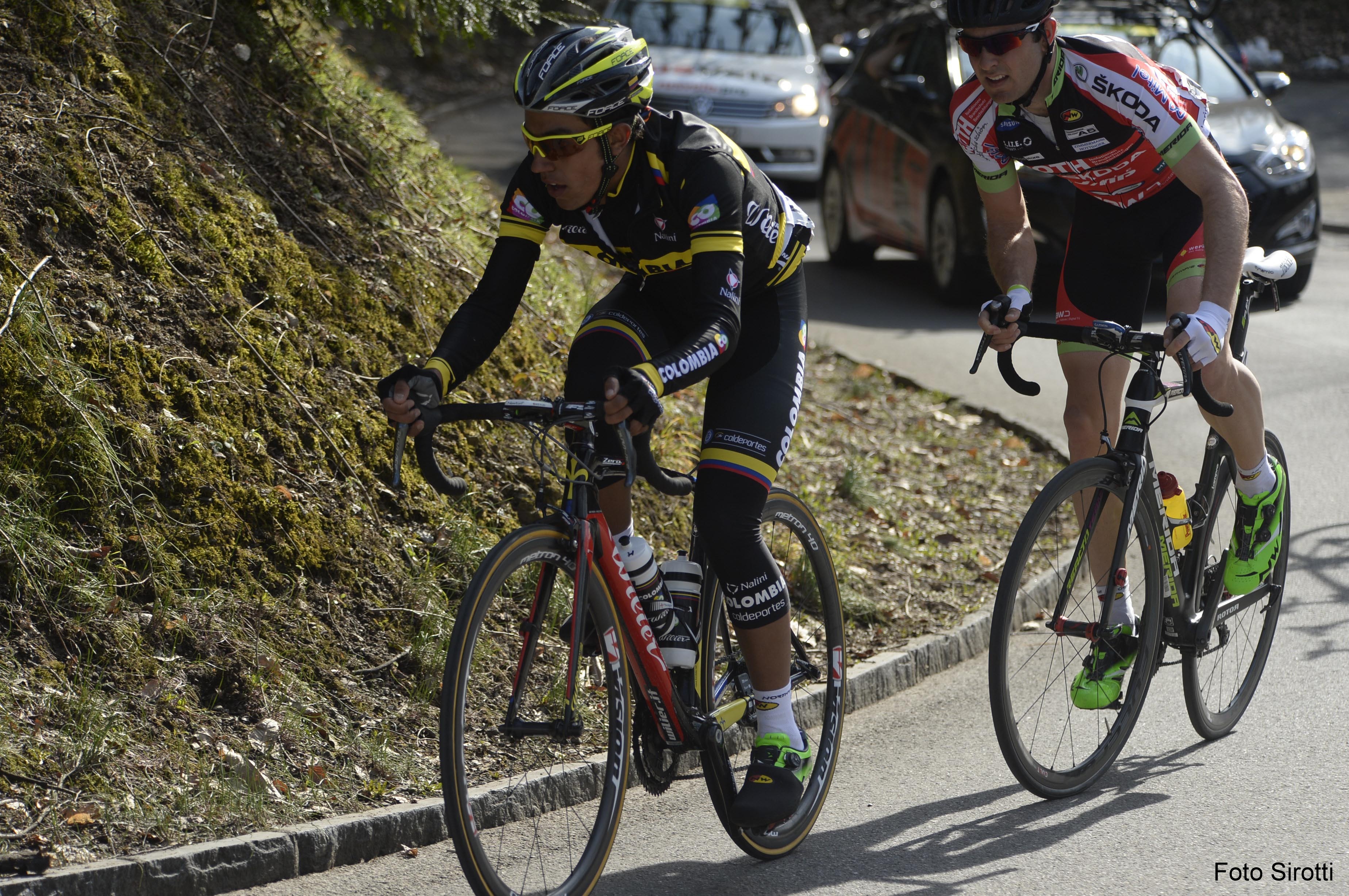
2015, Gp Lugano, Colombia 2015, Martinez Daniel, Ruvigliana

In the past couple of years, it became a habit to have a young Colombian rider making a name for himself in a tough race, despite lacking experience at pro level and riding against more powerful opponents. In 2015, the one coming into the spotlight was Daniel Martinez, the 19-year-old cyclist of Team Colombia-Coldeportes, who got his season started in February, at the Gran Premio Costa degli Etruschi, and needed only four months to draw attention upon him, at the Route du Sud, where he won the mountains classification.

Less than two months after completing the French event, he went to the Tour of Utah, where he turned into the revelation of the race, impressing everyone not only with his skills, but also thanks to the maturity displayed, well beyond his young age. In Utah – arguably the toughest cycling race in the US – he went head-to-head with the overall contenders on the Snowbird and Park City stages and finished 8th in the general standings, as well as taking home the best young rider jersey.

At the end of this week, Daniel Martinez will line-up for the 52nd edition of the Tour de l’Avenir, a race with which Colombian began an intense love affair since 1980, when Alfonso Florez nabbed a memorable victory against more well-known European riders. But before going to France, he took on the invitation of Cafe Roubaix and opened up about his first years in cycling and the results he got so far as a pro.

– Daniel, how did you began cycling?

It was through my brother, who liked cycling and started riding. Inspired by him, I began cycling at age 14, riding for the Club Ciclo Soacha. I remember everything from that time, from my first races, which were circuits and one-day races within the region, to watching the Grand Tours and wishing to get there in the future.

– How important was for you to win the Vuelta del Futuro in 2012?

It meant a lot: it was one of the most important races for my category, and I really wanted to win it. Moreover, I knew that a success would have opened many doors for me.

– Then, one year later, you took the gold medal in the Junior time trial race at the Panamerican Championships. Were you surprised by that victory?

No, I can’t say it came as a surprise, because I had worked a lot for that goal, and I had long been focused to go and win it.

– How did you end up in Europe?

The turning point was the World Championship in Florence, where I got in the breakaway: it actually opened the doors to Europe for me, as the next year the UCI invited me to the World Center.

– In 2014, you got to race in France, Switzerland and Spain, including the World Championships in Ponferrada. How would you rate this experience?

All these were amazing experiences, because there I had the opportunity to learn a huge lot on racing in Europe, and certain habitudes and routines that are part of it, and need to be apprehended. I also got to see that the races from Europe are longer and more organized, while the ones in South America are more “instinctual”.

– And all these races helped you turn pro.

I have to say that this was a very important step in my career. It was the goal that pushed me to start riding a bike in the first place.

– Recently, you finished 8th in the Tour of Utah. How was it?

It was by far the best race I have had as a profesional so far. I must admit that I was a little bit surprised to get such an important result. The feelings were good, but there were very strong opponents there.

– What improvements have you made this season?

The progress has been pretty significant. At the beginning, it was very hard to me to have good feelings deep into races, that is when the decisive moves happen. Now things are going pretty much better, and I feel more confidence and experience.

– Next up is the Tour de l’Avenir. What are your goals?

I am leaving for the race with many expectations, just like my other teammates, to go and put on a strong performance, trying to bring the overall title to Colombia once again.

Rider of the week

So far, 22 neo-pro managed to claim at least a win in the 2015 season, with Pierre-Roger Latour being the most recent to do this feat, in the last – and most difficult – stage of the Tour de l’Ain. After attacking on the penultimate climb of the day and giving it all, Latour kept enough in the tank to accelerate one more time on the final ascent and leave his countryman Fabrice Jeandesboz behind, thus taking home a big victory, on Lélex-Mont Jura, which helped him finish third overall, as well as notching up the U23 classification.

But who is this 21-year-old who made himself noticed long before the Tour de l’Ain? Born in the Drôme department, Pierre-Roger Latour showed his potential from early on, winning no less than four races in his first season as a cadet. Then, during his two-year spell in the Junior ranks, the lanky Frenchman scored ten wins and with each one of these confirmed that he’s poised to have a great future in the sport. For this reason, it wasn’t a surprise to see Chambéry Cyclisme Foundation – AG2R’s feeder team – offering him a contract and with it the opportunity to further develop.

As an U23 rider, Latour made steady progress and nabbed important top-10 placings in strong races as Ronde de l’Isard, Tour de l’Avenir, Tour des Pays de Savoie and even the Tour de l’Ain, where he raced as a stagiaire for AG2R, which soon put a pro contract on the table, not wanting to miss on one of the most talented young cyclists on the market. Even though is his first pro season, Latour didn’t waste time and besides the stage win in the Tour de l’Ain, he made a powerful impression in the Route du Sud, where he finished third overall, after staying with Alberto Contador and Nairo Quintana on the tough Port de Balès.

Now, after a season which can be easily labed as excellent, it will be very interesting to watch Pierre-Roger Latour’s development in the years to come, as well as the way he’ll manage – hopefully, with the help of his team – the extra pressure he’ll get from the French media, now that it’s a certainty he has all that it takes to be a Grand Tour contender in the future.

Ryan Mullen: “The ITT in Richmond is my biggest goal”

Cycling was an important part of Ryan Mullen’s family before he was even born, with his father riding as an amateur in Ireland for many years, so it wasn’t a surprise that Ryan got hooked early by this sport and began watching the Tour de France from a young age. When he turned 12, he started riding together with his father and the steps forward from that moment on came very natural, with Ryan Mullen embarking on his first road season in 2008.

The signs were more than encouraging, considering he won his first ever road race with an impressive display, leaving everyone behind and taking a solo victory. One year later, he got selected to represent Ireland at the European Youth Olimpic Games in Finland, another cornerstone in his career, which has been on the rise ever since, with Ryan Mullen confirming his huge potential in the individual time trial, a discipline in which he clocked up many noteworthy results.

As it goes, the young Irish cyclist came second at the European Championships in the Juniors’ race, before notching up his first big victory, in the Chrono des Herbiers, a result that got him a contract with IG-Sigma Sport, where he continued to make steady progress. His performances didn’t go unnoticed and in the following season he signed for An Post Chain Reaction. During his first season with the Continental squad managed by Kurt Bogaerts, Ryan Mullen took the U23 time trial title, as well as winning the elite road race, an astonishing feat which brought him even more into the spotlight.

Then, in September, he came as one of the favorites at the start of the World Championships in Ponferrada, but missed out on winning the Under-23 time trial title for just 0,48 seconds. It was a big disappointment for the Irishman, but he eventually got over it and came back stronger from this, confirming that he’s one of the brightest talents on the U23 scene and scoring another string of strong results, including the national time trial title in the elite ranking and a third place in An Post Ras, despite being hit by injuries and crashes during the first months of this season.

Now entering in a very busy period of the year and fully focused on the last weeks of the season, with the Richmond World Championships being the climax of his preparation, Ryan Mullen took some time recently to talk for Cafe Roubaix of his 2015 results and future goals. You can read all about it in the following interview.

– Ryan, you’ve been part of An Post team since 2014. How much did it help you to develop?

Being a part of An Post Chain Reaction has been amazing for me. I’ve been given a great racing programme and I’ve learned so much about cycling in the last year and a half. We ride a lot of the high level races and it’s helped me develop so much. Without the racing programme and the structure and support I’ve received I wouldn’t have got the results I’ve had today. Having Sean Kelly and Kurt Bogaerts as mentors helped smooth my transition from having no experience in UCI road races to medalling in the World Championships last year. I’m very grateful for their help.

– Since then, you’ve had your share of wins and defeats. Which would you say that was your top moment?

I would say my proudest yet most disappointing moment was definitely finishing second in the World U23 ITT Championships. Although I lost out by 0,48 seconds, it is something I will never forget and I’m very proud of that result. But at the same time it took me a long time to get over the fact that I was a blink of an eye off being World Champion. It was a huge moment for me in my career and it was the result of a lot of hard work that both myself, my team and my national federation put in. I was hugely disappointed I couldn’t win to repay them for all their hard work, but at the same time I am very proud of my silver medal.

– Were there any positives after that?

Yes, after that defeat in Ponferrada, I can say there were many positives. I learned to appreciate that in the future every little detail counts. But more importantly it made me realise that I have the potential to win this race one day. It put belief in me.

– Did you get any offers to turn pro at that moment?

There was interest from teams directly after the race. But I made the decision to stay with An Post for one more year so I could further develop myself as a road rider. I feel that at the moment, I lack the skill and experience of a World Tour racer, which was a big deciding factor in me wanting to remain at Continental level for another year.

– How would you rate your 2015 season so far?

This season is starting to go a little bit better for me. It started terribly. I was massively fatigued and run down from a hard winter on the track with the national team where I went to South America five times in the space of 10 months. I didn’t get any rest after the Road Worlds, I went straight in to a track camp. Things didn’t go to plan with crashes and injuries. I went to the Track World Championships in Paris and was below my expectations in getting seventh in the Individual Pursuit. After that, again, I didn’t have much rest as I was straight into the road season. It took me a long time to get going and I went without a single result for the first half of season. I began to doubt myself and my confidence was at an all time low after crashing out of the U23 Tour of Flanders. I had a bout of tendonitis for two and a half weeks after that, so I missed a huge block of racing and training. I came back with nothing. My team were understanding and still gave me good quality race days to build my fitness again before the summer.

– What meant for you to shine again at the Nationals?

It was huge for me to go back to the Nationals and win the Elite time trial. I was ill at the time with a stomach bug I picked up coming back from the Bake games, so to still pull off a result meant a lot to me. I really wanted to win the Elite time trial this year. I consider it one of my proudest moments in my career. There was pressure on me to perform on a hard course, with a little bit of jet lag added in to make things more difficult me for. I’m more proud of the Elite time trial title than I am of my Elite road race victory in 2014.

– How were the European Championships in Tartu?

The European Championships went pretty okay for me. I’ve just started back after my break and I was very happy to finish where I did. I came to the Championships hoping for a medal again. I was one second off bronze. It is disappointing for me to lose out by such a small margin again, but the bigger picture for me is the World Championships. After my break I lack road racing and that’s where I get my fitness and strength for the time trials. So to be so close with so little preparation is good for my confidence. Now everything is being built towards going one better in Richmond. But I know it isn’t going to be easy and I’m not for one second going in to the Worlds thinking I’ll get things for granted. I know it will be hard and I’m going to fight for it.

– So the time trial race in Richmond is a big goal for you.

The individual time trial in Richmond is the biggest goal of the year for me. Nothing else matters for me apart from a result there. I have some demons to put to bed. The course looks good. I won’t get a good idea of it until I ride it. But on paper it looks easier than last year. We’ll see how it goes. I have a good programme till then which should bode me well for any course no matter how hard it is.

– And besides that? Any other targets you have for 2015?

I would like to show myself in a road race at some point this year. I feel like every road race I have done this year has purely been training for a different event. I have a lot of road races this month, so to get a result in one of them will make me very happy.

– Where do you see yourself in a couple of years? What races would you like to win as a pro?

In a few years time, I’d like to be in the World Tour. I want to stay focussed on time trials. I think it is somewhere that I have the ability and physique to achieve results. It’s something I don’t want to let slip away. In the long run I would like to become a GC contender for week-long stage races. I know I’ll have a lot of work to do to get there, but I think with the right training, diet and attitude it should be achievable for me. If I had to name one race I want to win as a professional, it would be the World Time Trial Championships.

2015 Vuelta a España Startlist

AG2R: Gediminas Bagdonas, Mikael Cherel, Alexis Gougeard, Blel Kadri, Sebastien Minard, Matteo Montaguti, Rinaldo Nocentini, Domenico Pozzovivo, Johan Vansummeren.

Astana: Fabio Aru, Dario Cataldo, Mikel Landa, Vincenzo Nibali, Diego Rosa, Luis Leon Sanchez, Paolo Tiralongo, Alessandro Vanotti, Andrey Zeits.

BMC: Darwin Atapuma, Marcus Burghardt, Alessandro De Marchi, Jean-Pierre Drucker, Amael Moinard, Joey Rosskopf, Samuel Sanchez, Tejay van Garderen, Peter Velits.

Caja Rural: David Arroyo, Carlos Barbero, Pello Bilbao, Omar Fraile, Jose Gonçalves, Angel Madrazo, Luis Mas, Amets Txurruka, Ricardo Vilela.

Cannondale-Garmin: André Cardoso, Joe Dombrowski, Alex Howes, Ben King, Daniel Martin, Matej Mohoric, Moreno Moser, Andrew Talansky, Davide Villella.

Cofidis: Yoann Bagot, Nacer Bouhanni, Romain Hardy, Cyril Lemoine, Daniel Navarro, Dominique Rollin, Stephane Rossetto, Julien Simon, Geoffrey Soupe.

Colombia-Coldeportes: Alex Cano, Fabio Duarte, Leonardo Duque, Walter Pedraza, Carlos Julian Quintero, Brayan Ramirez, Miguel Angel Rubiano, Rodolfo Torres, Juan Pablo Valencia.

Etixx-Quick Step: Maxime Bouet, Gianluca Brambilla, David De La Cruz, Iljo Keisse, Nikolas Maes, Pieter Serry, Niki Terpstra, Martin Velits, Carlos Verona.

Europcar: Yukiya Arashiro, Jerome Cousin, Antoine Duchesne, Jimmy Engoulvent, Cyril Gautier, Tony Hurel, Fabrice Jeandesboz, Pierre Rolland, Romain Sicard.

FDJ: Arnaud Courteille, Mikael Delage, Kenny Elissonde, Murilo Fischer, Olivier Le Gac, Lorrenzo Manzin, Laurent Pichon, Kevin Reza, Jussi Veikkanen.

Giant-Alpecin: Lawson Craddock, Koen de Kort, John Degenkolb, Tom Dumoulin, Johannes Frohlinger, Luka Mezgec, Tom Stamsnijder, Zico Waeytens.

IAM Cycling: Marcel Aregger, Sylvain Chavanel, Jerome Coppel, Thomas Degand, Simon Pellaud, Matteo Pelucchi, Vicente Reynes, David Tanner, Larry Warbasse.

Katusha: Vladimir Isaychev, Pavel Kochetkov, Alberto Losada, Tiago Machado, Daniel Moreno, Joaquim Rodriguez, Gatis Smukulis, Angel Vicioso, Eduard Vorganov.

Lampre-Merida: Mattia Cattaneo, Valerio Conti, Kristijan Durasek, Tsgabu Grmay, Ilia Koshevoy, Przemyslav Niemiec, Nelson Oliveira, Ruben Plaza, Maximiliano Richeze.

LottoNL-Jumbo: George Bennett, Martijn Keizer, Bert-Jan Lindemann, Timo Roosen, Mike Teunissen, Maarten Tjallingii, Tom Van Asbroeck, Dennis Van Winden, Maarten Wynants.

Lotto-Soudal: Kris Boeckmans, Jasper De Buyst, Bart De Clercq, Thomas De Gendt, Adam Hansen, Maxime Monfort, Jurgen Van Den Broeck, Tosh Van Der Sande, Jelle Vanendert.

Movistar: Andrey Amador, Imanol Erviti, Javier Moreno, Nairo Quintana, Jose Joaquin Rojas, Rory Sutherland, Alejandro Valverde, Francisco Ventoso, Giovanni Visconti,

MTN-Qhubeka: Natnael Berhane, Stephen Cummings, Songezo Jim, Louis Meintjes, Youcef Reguigui, Kristian Sbaragli, Jay Thomson, Johann Van Zyl, Jaco Venter.

Orica-GreenEdge: Esteban Chaves, Mitchell Docker, Caleb Ewan, Simon Gerrans, Mathew Hayman, Damien Howson, Daryl Impey, Jens Keukeleire, Cameron Meyer.

Sky: Ian Boswell, Chris Froome, Sergio Henao, Vasil Kiryienka, Christian Knees, Mikel Nieve, Salvatore Puccio, Nicolas Roche, Geraint Thomas.

Tinkoff-Saxo: Daniele Bennati, Maciej Bodnar, Pavel Brutt, Jesper Hansen, Rafal Majka, Jay McCarthy, Sergio Paulinho, Pawel Poljanski, Peter Sagan.

Trek Factory Racing: Fabian Cancellara, Markel Irizar, Yaroslav Popovych, Franck Schleck, Jasper Stuyven, Boy van Poppel, Danny van Poppel, Riccardo Zoidl, Haimar Zubeldia.

Who will win the Vuelta a España?

Rider of the week

In 2012, after taking the overall classification in the Girobio ahead of Fabio Aru, Davide Formolo and Ilnur Zakarin, Joe Dombrowski was widely regarded as the next big thing of US cycling, many tipping him for a Grand Tour victory in the years to come. After that season – in which he got other impressive results in the Tour of California and USA Pro Cycling Challenge, racing agains the pros – the 21-year-old was signed by Sky, but the move didn’t turn out to be a match made in heaven, the main reason being a medical problem (iliac artery endofibrosis) that hampered his two-year spell with the British outfit.

With Sky not extending his contract beyond 2014, Dombrowski had to search for a new team, and it didn’t took him too much to find it, as Cannondale-Garmin was eager to take him aboard and came with an offer. The young climbing ace didn’t weigh too much on this, as he saw the transfer to the US-based squad as an excellent opportunity to relaunch his career and find the form that has helped him shine in the seasons spent as an U23 cyclist with Bontrager-Livestrong.

The signs that Joe Dombrowski started to regain his legs were there early in the year, at the Tour de San Luis, where he finished 7th. Then, the beginning of the Spring wasn’t very satisfactory, but the tables eventually turned around in the Tour of California, where the former Girobio winner came home 4th, a result reminiscent of his 2012 season. Finishing just outside the podium left Dombrowski very confident ahead of his next appointments and hungry for more, a big result looking to be just around the corner.

Cannondale-Garmin’s leader at the start of the Tour of Utah, the rider from Virginia stayed safe during the first stages of the week-long event and made sure of not losing any time to his rivals, before storming away on Snowbird (10,8 kilometers, 7,5% average gradient), in the penultimate stage, putting on a fantastice surge with more than six kilometers to go, that let all the other GC contenders in the dust.

Thanks to an impressive cadence (which didn’t overshadow his elegant style), Dombrowski claimed his maiden pro victory, which confimed the huge potential that heralded him when he turned pro, in 2013. Getting also the yellow jersey on his shoulders, the 24-year-old put on another dominant display one day later, on Empire Pass – one of the toughest climbs in the US (12,7 kilometers, 7,7% average gradient) – marking all his opponents and sealing the overall classification win in Park City, where he became the 7th US cyclist to triumph in the Tour of Utah.

With the Vuelta a España ready to hit it off in less than two weeks – a race that will provide opportunities galore to the climbers – and taking into account his superb form, Joe Dombrowski can be one of the revelations there, despite making his debut in a Grand Tour. After all, he’s not the future of US cycling anymore; he’s the present of it.

Eneco Tour Stats

Historical stats

– Edvald Boasson Hagen and Jose-Ivan Gutierez share the record for the most overall wins, two

– Edvald Boasson Hagen (22 years) is also the youngest rider to take the GC, while Bobby Julich is the oldest one (33 days)

– Tom Boonen and André Greipel have the most stage victories, six each

– Jack Bobridge (21 years) is the youngest ever stage winner; Robbie McEwen (38 years) is the oldest one

– Between 2005 and 2007, the leader’s jersey was red, but starting from 2008 it was changed to white

– Germany, Norway and Spain are the countries with the most overall wins, two

– 16 countries have won at least one stage: Australia, Belgium, Brazil, Canada, Czech Republic, Denmark, France, Germany, Great Britain, Italy, Latvia, New Zealand, Norway, Spain, The Netherlands, U.S.A.

– Bobby Julich (USA) is the only cyclist from outside of Europe to triumph in the race

– No road race world champion or Tour de France winner has ever finished first in the Eneco Tour

– The smallest time gap between the first two was recorded in 2006, when just one second has separated Stefan Schumacher and George Hincapie

– In 2009, Edvald Boassin Hagen won ahead of Sylvain Chavanel for 45 seconds, the largest ever time gap

2015 stats

– 20 teams (17 World Tour, 3 Pro Continental) will be at the start of the 11th edition

– Roompot is the only one of these without a victory in the 2015 season

– The race will consist of six stages in line and an individual time trial, making-up for a total of 1120,7 kilometers

– The peloton of the 2015 race has won a combined total of 11 Monuments, 5 World Titles and more than 50 Grand Tour stages

– Lars Boom and Tim Wellens are the two former winners to line-up at the start

– 27 nations will have at least a rider in the race, with Belgium topping the standings (35)

– Eight national champions will compete in the event: Hugo Houle, Christopher Juul-Jensen, Wilco Kelderman, Adriano Malori, Ramunas Navardauskas, Aleksejs Saramotins, Gatis Smukulis and Preben Van Hecke

– Andre Looij (21 years) is the youngest cyclist to ride the Eneco Tour (21 years); Greg Henderson (38 years) is the oldest one

Navigare în articole