Cafe Roubaix

Despre ciclismul de azi şi cel de altădată

Archive for the month “mai, 2015”

2015 Giro d’Italia – Stage 1 Preview

T01_SanRemo_TTT_alt

For the second year in a row, the Corsa Rosa will kick off with a team time trial, which starts from the Ligurian coast, this being the 5th time in the Giro’s history when it will begin here, after 1980, 1987, 1992 and 2007. The race starts from San Lorenzo al Mare, ends in Sanremo and is 17,6 km-long. While the route – which has an intermediate point halfway throught he stage – isn’t technical, it poses a problem as it will be run mainly on narrow cycle paths, before finishing on the Lungomare Italo Calvino, where “La Primavera” used to end up until this year, when the arrival was moved back to Via Roma.

Last year, Orica-GreenEdge won the Giro d’Italia TTT in Belfast in commanding fashion and will look to repeat that feat and thus take the first pink jersey of the race. The team from Down Under has some very powerful engines, such as Luke Durbridge, Michael Hepburn and Brett Lancaster, and their presence should be enough for the victory in Sanremo. On paper, Sky and Tinkoff-Saxo will be fighting for second place, but also to give their leaders a chance to put some seconds into their opponents, which can act as a first psychological win.

Sky put on an impressive display in the Giro del Trentino and Tour de Romandie TTT, so it should have an upper hand, but Tinkoff-Saxo – while it isn’t a team known for its great time trial – always founds something extra in a Grand Tour, which helps the riders get a good result. Finally, two other squads that can dream of a podium are BMC (the world champion from Ponferrada) and Katusha, with the Russian outfit capable of putting its captain, Ilnur Zakarin, in a great position from the first day of the race, just as it did in April’s Romandie time trial. For other teams which are hoping for a good overall classification – Etixx-Quick Step, Movistar, Astana and AG2R – it will be all about protecting their GC cyclist and making sure they will not lose too many seconds on Saturday.

A Giro d’Italia stage hasn’t finished in Sanremo since 2001, when Pietro Caucchioli took the victory, ahead of Jose Azevedo and Jan Ullrich, while Italy’s Gilberto Simoni was 14th and kept his pink jersey, which he eventually took home.
2015 Giro d’Italia – Teams Analysis

AG2R – travelling to the Corsa Rosa with an in-form Domenico Pozzovivo (who recorded top 10 finishes in all five races he took part so far this year), the French squad will hope to see the pocket climber get a stage win and a top 5 in the overall classification. The roster also includes Carlos Betancur, former winner of the white jersey at the Giro, and it will be interesting to see if he can regain top form and go for a stage. If the Colombian fails again, then it’s difficult to believe he can come back to the top.

Androni Giocattoli – three years have passed since the boys of Gianni Savio took a victory in their home race, so the pressure is on to finally get that stage win that has eluded them for so long. Franco Pellizotti doesn’t seem capable of returning to the form that has helped him finish on the podium in the past, but he can still fight for a stage, especially considering he will get the support of such riders like Simone Stortoni and Serghei Tvetcov. Gianfranco Zilioli is a good shot at a win from a break, while Davide Appollonio and Oscar Gatto will try to mix in the sprints and notch some top 10 placings.

Astana – after his fantastic 2014, Fabio Aru is considered one of the main contenders and his fellow countrymen have big expectations from him. But it will not be easy for the talented Sardinian, who missed important race and training days after falling ill in the past weeks. Besides this, there’s also the long individual time trial from Treviso to Valdobbiadene, which will not work in his favor, and that means Aru has small chances of even being on the podium in Milan. Some stage wins are more likely, besides Aru, other strong Astana candidates being Mikel Landa, Diego Rosa and Paolo Tiralongo.

Bardiani – a team which was the attacking spirit in its blood, Bardiani should score a win and also fight for the mountains classification, thanks to Stefano Pirazzi. Nicola Ruffoni and Sonny Colbrelli will try to be there in the sprints, depending on the course, while Enrico Battaglin and Francesco Manuel Bongiorno are going to join the breakaways in the mountain stages, which will provide them a nice opportunity to get a victory.

BMC – Philippe Gilbert returns to the Giro for the first time in six years and he’ll be keen on making up for a lackluster Ardennes campaign. Even though Damiano Caruso heads the team’s GC bid, when the terrain becomes difficult, look to Colombia’s Darwin Atapuma, who has an important chance of raising his arms in joy on one of the arduous climbs of the Corsa Rosa. Of course, many will also have high hopes from Stefan Küng, already one of the best neo-pros of the season.

Cannondale-Garmin – Ryder Hesjedal has a special relationship with the Giro d’Italia, so the Canadian hopes he can go once again for a top result, although he’s aware that it will be very difficult even to end up in the top 5. Making his debut in a Grand Tour, Davide Formolo – runner-up at the 2014 National Championships – is a promising rider and he should have some opportunities to make himself noticed in the first two weeks.

CCC Sprandi Polkowice – Sylvester Szmyd said he rediscovered his best legs, but also his passion for cycling, which makes him an important man for the Polish squad once the road starts to rise, especially in the last week. Winner of the Tour of Croatia last month and of a Tour of Catalunya stage in March, Maciej Paterski is a good bet from an escape, while the 29-year-old Grega Bole looks poised not to miss a sprint that comes at the end of a selective course.

Etixx-Quick Step – after achieving back-to-back podiums at the past two editions, Rigoberto Uran will once again be a top contender. It’s true that the Colombian lacks some of his rivals’ explosiveness on the mountains (and some real helpers), but he has what it takes to turn the tables around in the 59 km-long individual time trial, where he can put minutes between him and other GC men. Keep an eye also on Tom Boonen, who is making his debut in the Giro.

FDJ – by the looks of it, Marc Madiot’s squad should be the Cinderella of this edition, a team that will have a hard time to feature even in escapes. Still, 27-year-old Alexandre Geniez seems to be having some shape coming into the race – as he has won the Tro-Bro Leon in April – so he’ll surely try something on the mountains, where Kenny Elissonde is also expected to resurrect his career after a disappointing 2014 season.

Giant-Alpecin – first ever Slovenian to take a victory in the Corsa Rosa, Luka Mezgec returns to Italy with a solid team around him, whose mission is to get him in the best position for the sprint. Mezgec isn’t the fastest, but he’s a smart rider and can add a win to his CV this May. But the 26-year-old is also a consistent cyclist and thanks to this he could end up fighting for the points classification. At some moment during the race, expect to see Tobias Ludvigsson and Simon Geschke going into the break.

IAM Cycling – Sylvain Chavanel will race the Giro d’Italia for the first time and will have the opportunity to target some stages and thus save what was a disappointing Spring. Matteo Pelucchi is a rider to be watched in the sprints, where he has what it takes to surprise the big favorites, while Sebastien Reichanbach is going to lead the team for the first time in a Grand Tour and will get support from one of the most interesting neo-pros out there, Clement Chevrier.

Katusha – Luca Paolini will be the captain of the team during the three weeks and his huge experience will surely make the difference as the Russian outfit will be going in many breakaways, in order to nab a stage win. On the other hand, in the roster there’s also Ilnur Zakarin, who is an even more interesting prospect now that he has conquered the Tour de Romandie. The 25-year-old can be one of the race’s revelations and finish in the top 10, but it will all depend on what he’ll do in a very tough last week.

Lampre-Merida – last season, Diego Ulissi had a great run in the Giro, winning two stages (Viggiani and Montecopiolo), but afterwards he was tested positive and missed for almost a year from the peloton. Now he’s back, but it will be a hard task for him to have the same success as in 2014, so Lampre will look up to Sacha Modolo for a win from a bunch sprint and to Przemyslaw Niemiec in the mountains, where the Pole can hope for a nice placing in the GC.

LottoNL-Jumbo – less than a week ago, in the Tour de Yorkshire, the Dutch team notched its first victory of the season, thanks to Moreno Hofland, who will be its main bet for the Corsa Rosa in the flat days. The line-up also includes Steven Kruijswijk – 8th at the 2011 edition – whose main goal this year is the first Grand Tour of the season. Kruijswijk didn’t shine so far in 2015, but the Giro can be the much desired wake-up call.

Lotto-Soudal – the team has decided to send Jurgen Van Den Broeck in the Giro, as a last chance for the Belgian rider to prove he’s GC material, but their main hope lies in André Greipel, who should clock at least a stage win in the first two weeks, after which he can retire in order to focus on the Tour de France. Another rider to follow from Lotto-Soudal will be Louis Vervaeke, one of the most promising neo-pros of the peloton, who had a very impressive run in 2014, as an amateur.

Movistar – this is one of the most powerful teams in the race, capable of putting up a great show and notching at least two stage wins, as well as a strong GC result. Juan Jose Lobato is going to try his luck in the sprints that pose a more difficult terrain, Giovanni Visconti will go in the breaks, while Igor Anton looks to have found his mojo again, just ahead of a race with climbs that really suit him. As for the overall, Beñat Intxausti will be Movistar’s man, but watch out for Ruben Fernandez, the 2013 Tour de l’Avenir winner, who has made some significant improvements.

Nippo-Vini Fantini – Damiano Cunego showed some good form in the events leading up to the Giro d’Italia (Giro del Trentino and Giro dell’Appennino) and this made people think he can have a go at the overall classification. Thing is that it’s very difficult for Cunego to be a protagonist in the GC, a thing even he knows, and this means “Il Piccolo Principe” will be in the hunt for stage wins, with the best climber jersey providing another opportunity for the former winner of the event to shine. Besides him, Eduard Grosu and Daniele Colli will try to be up there in the sprints.

Orica-GreenEdge – is a team of stage hunters, capable of winning on any terrain. Michael Matthews will try to add at least a win to his growing palmares, Simon Gerrans will look for his first victory since last Fall in the hilly stages, while the small Colombian Esteban Chaves can light-up the fireworks on the mountains. In Orica’s roster there’s also another big talent, Luke Durbridge, who should have a go in the long individual time trial that comes at the end of the second week.

Southeast – the Pro Continental outfit gets to ride the Giro d’Italia only thanks to winning the Coppa Italia last season, so will try to put the doping scandals in the past and show it deserves to be here. Alessandro Petacchi is the team’s leader, but in the sprints he’ll guide Manuel Belletti, who is Southeast’s best shot in this kind of stages. Otherwise, Mauro Finetto and Francesco Gavazzi can go in an escape or wait for the hilly stages of the race to make amends and bring their team a much needed victory.

Sky – Richie Porte is the absolute leader of a team which includes Mikel Nieve, Leopold König, Kanstantsin Siutsou and Sebastian Henao, the Aussie coming hear after his best ever Spring campaign, with GC wins in Paris-Nice, Volta a Catalunya (where he outshone Alberto Contador) and the Giro del Trentino. Still, there’s a question mark when it comes to Porte and Grand Tours, as he usually has a bad day during these races and ends up bleeding minutes. On the other hand, if he can keep the form displayed during the past months, Richie Porte will give everyone else a run for their money. When Sky’s riders won’t be busy protecting him, they will try to help Elia Viviani get that stage win he dreams of for so long.

Tinkoff-Saxo – every member of the team is here for Alberto Contador, who wants to win the Giro d’Italia for the second time (and this time for good, after he was stripped of his 2011 triumph). Unlike many of his opponents, the Spaniard took a long break from races and went for altitude training, hoping it will pay off now. Backed by a fiercely-strong team, that includes Ivan Basso, Roman Kreuziger and Michael Rogers, Contador starts as the main contender for the win, and if he will have the same form as in last year’s Vuelta, then the Trofeo Senza Fine should be his.

Trek Factory Racing – this isn’t the “A” team of Trek, but don’t underestimate the cyclists of the American squad, as they are capable of getting more than a stage victory. Italy’s Giacomo Nizzolo has a strong train for the flat and can contend not only for a win, but also for the points jersey, while Fabio Felline – who’s had a superb Spring so far – will wait for the lumpy days, where his fast kick can be of big help if a reduced peloton gets to the finish.

Gianfranco Zilioli: Ready to lay his mark on the Giro d’Italia

When he was just 6-years-old, Gianfranco Zilioli has started cycling out of fun and to spend more time to his friends. Also back then, he used to play football a lot, which wasn’t recommended for a rider, as it was (and still is) an injury-prone sport. He mixed the two for a couple of seasons, but eventually, in his second year as a junior, the young Italian shifted his priorities, burned out some kilograms and decided to focus only on cycling, which turned out to be the right thing to do, as he became a pro with Androni Giocattoli, in 2014, after taking an impressive solo win as a stagiaire in the Gran Premio Industria & Commercio di Prato.

His first year in the pro ranks was equally impressive, with top 10 placings in stage races (Tour de Langkawi, Sibiu Tour) and one-day races (Giro dell’Emilia) alike, proving that he can become one of the most important Italian cyclists coming from the new wave. These results, alongside the determination displayed and his continuous development, have helped Gianfranco Zilioli make the team for the 98th running of the Giro d’Italia. Just before going to San Lorenzo al Mare, the rider of Androni Giocattoli-Sidermec sat down and talked for Café Roubaix about his season and expectations ahead of the Corsa Rosa.

– Gianfranco, you are a pro since 2014. How was the transition from the amateur ranks?

Can’t say it was easy, as I had difficulties with the changing of pace. I began the season with many kilometers under the belt, so the rhythm looked ok in the first months of the year, but once I took part in bigger races, where the peloton was much stronger, I found it hard to blend in and find my pace. On the other hand, I must admit I’m happy with the top 10 placings I got.

– What did you improve in the past year?

I became much stronger on the flat, but without losing the power I have on the climbs. And this was very important for me, as I’m a passista-scalatore.

– And on what do you still want to work on?

I’m very keen on improving my sprint. It doesn’t matter what type of rider you are, fact is that when you hit the final meters of a race and you’re not alone, it’s very important to have that extra kick that can help you take the win.

– You have 23 race days in 2015. Are you satisfied with the way things went so far?

My preparation for the first half of the season was a quiet one, which was very important. During the winter, I stayed in the gym and went trekking on the mountains, so that I can have a nice fitness level for the start of the season. Eventually I took my bike out for a ride, because I couldn’t stay any longer without it, as my first race of the year – the Tour de San Luis – came early.

– Recently, you finished 17th in the Giro del Trentino, after an aggressive display. How was the race?

The Giro del Trentino is an important event for the teams and riders alike, in order to find out where they stand before the Giro d’Italia. After the Settimana Internazionale di Coppi e Bartali, in March, I went at altitude together with Franco Pellizotti, in order to be well-prepared for the start of Trentino. During the race, and especially in stage two, I tried to stay with the best, and in the last day I wanted to keep to the team’s philosophy and go in the breakaway.

– Last season, in May, you raced the Tour d’Azerbaidjan. Now, one year later, you’re going to make your Giro debut. How do you see this experience?

I’m nervous and excited, and can’t wait to get to Sanremo to be with the team and support it. For me, as for many Italian cyclists, this is a dream come true. When I was just a kid, I was glued to the TV every day to watch the Giro d’Italia stages. After the stage was over, I used to take my bike to the garden and pretend I’m attacking during a Giro stage. Now I’m going there and I’m prepared to help the team and also go in some breakaways.

– What do you think of the course?

I think it’s a difficult one, but a very good thing is that there won’t be any long transfers, as this would have made a negative impact on the riders during the three weeks of the event. In a Grand Tour, it’s very important to get some rest and be fresh at the start of each day. If you get an extra hour of sleep a day, this means that at the end of the Giro you have one extra rest day in comparison to your opponents.

Giro d’Italia Stats

Historical stats

– The race was created in 1909 and the inaugural edition was won by Luigi Ganna

– In 1912 there was no individual classification, but a team classification, won by Atala

– Alfredo Binda, Fausto Coppi and Eddy Merckx share the record for the most GC wins, five each

– Italy leads the nations standings, with 68 triumps, way head of Belgium, which has only seven

– Felice Gimondi has the most podium finishes: 9

– Longest edition took place in 1962 (4180 kilometers), while the shortest one was the inaugural one (2445 kilometers)

– The race had 11 foreign starts until now: San Marino (1965), Monaco (1966), Belgium (1973), Vatican (1974), Greece (1996), France (1998), Netherlands (2002), Belgium (2006), Netherlands (2010), Denmark (2012), Northern Ireland (2014)

– Fausto Coppi is the youngest ever winner: 20 years and 268 days (1940); the oldest winner is Fiorenzo Magni: 34 years and 180 days (1955)

– Olimpio Bizzi (19 years and 299 days in 1936) is the youngest stage winner, while Giovanni Rossignoli (37 years and 186 days in 1920) is the oldest one

– In 1932, Giovanni Gerbi – 47 at that time – became the oldest rider to compete in the event

– Wladimiro Panizza has the most Giro d’Italia starts (18) and finishes (16)

– Between 1909 and 1913, the scoring format used a points-based system, which was subsequently changed to a time-based system

– Only three cyclists from outside of Europe have won the race: Andrew Hampsten (U.S.A.), Ryder Hesjedal (Canada) and Nairo Quintana (Colombia)

– The pink jersey is awarded to the race leader since 1931 and the first rider to wear it was Learco Guerra

– Eddy Merckx has the most days in the maglia rosa, 79

– Andrea Noe is the oldest ever cyclist to take the pink jersey: 38 years in 2007

– Four riders have led the race from start to finish: Costante Girardengo (1919), Alfredo Binda (1927), Eddy Merckx (1973) and Gianni Bugno (1990)

– Two cyclists have lost the race in the last day: Laurent Fignon (1984) and Joaquim Rodriguez (2012)

– There are 14 riders who have won the overall without taking a stage win

– Longest ever stage took place in 1914 (Lucca-Rome, 430 km), and was won by Costante Girardengo

– Shortest one was won by Roger Swerts – 20 kilometers starting and finishinf in Forte dei Marmi – in 1972

– The longest ever individual time trial came at the 1951 edition – 81 kilometers between Perugia and Terni – and was won by Fausto Coppi

– Switzerland was the first foreign country to be visited by the peloton, in 1920

– In 1921, the race began to be filmed in order to be screened in cinemas

– 1928 was the year with the most cyclists at the start: 298

– Alfredo Binda holds the record for the most consecutive stage wins, 8 in 1929, and for the most stage wins at one edition, 12 in 1927

– Another Italian, Mario Cipollini, has the most stage in the history of the Giro: 42

– The mountains classification was introduced in 1933, same year an individual time trial took place

– First edition to feature the Dolomites was the 1937 one; same year, the team time trial was introduced

– The closest winning margin Giro history came in 1948, when only 11 seconds separated Fiorenzo Magni and Ezio Cecchi

– The largest winning margin was recorded in 1914, when Alfonso Calzolari won for 1h 57’ 26’’

2015 stats

– 22 teams (17 World Tour, 5 Pro Continental) will line-up for the 98th edition of the Corsa Rosa

– Of these, two are winless this season: Bardiani and Nippo-Vini Fantini

– The 2015 race start in San Lorenzo al Mare and finishes in Milan, after 3481,8 kilometers and 43 000 meters of vertical climbing meters

– This is going to be the 9th time when the Giro d’Italia kicks off with a team time trial

– Four former winners are at the start of the Giro d’Italia this year: Ivan Basso, Alberto Contador, Damiano Cunego and Ryder Hesjedal

– Sky and Trek are only teams not fielding a single rider from the country in which they are registered

– Cyclists from 36 countries will run the Giro d’Italia: Albania, Argentina, Australia, Austria, Belarus, Belgium, Brazil, Bulgaria, Canada, China, Colombia, Costa Rica, Czech Republic, Denmark, Estonia, Ethiopia, Finland, France, Germany, Italy, Japan, Kazahstan, Latvia, Netherlands, New Zealand, Panama, Poland, Portugal, Romania, Russia, Slovenia, Spain, Sweden, Switzerland, U.S.A., Venezuela

– As expected, Italy has the most riders in the peloton: 59

– Germany’s Rick Zabel (21 years) is the youngest cyclist at the start, while Alessandro Petacchi (41 years) is the oldest one

– The riders who are at the start have won a combined total of 10 Grand Tours, 14 Monuments, 5 world titles (RR+ITT) and more than 150 Grand Tour stages

– Seven neo-pros will make their debut in a Grand Tour: Giacomo Berlato, Clement Chevrier, Luca Chirico, Eduard Grosu, Stefan Küng, Riccardo Stacchiotti and Louis Vervaeke

2015 Giro d’Italia favorites – race days/wins

Fabio Aru – 15/0

Damiano Cunego – 16/0

Alberto Contador – 19/1

Beñat Intxausti – 25/0

Domenico Pozzovivo – 25/2

Rigoberto Uran – 25/1

Jurgen Van Den Broeck – 25/0

Ilnur Zakarin – 26/1

Ryder Hesjedal – 29/0

Richie Porte – 33/9

Conclusions after the Ardennes Classics

Alejandro Valverde came out of the Ardennes as the king of these races, after finishing second in Amstel Gold Race and winning both Flèche Wallonne and Liège–Bastogne–Liège. By doing this, he entered the history books as only the second ever cyclist – after Ferdi Kübler – to make this memorable double. In both races, the Spaniard was very powerful and had a flawless tactic, two things which helped him control the other contenders and eventually outsprint them. Although he remains a controversial figure because of his dodgy past, one can’t overlook the fact that the 35-year-old remains one of the best riders in the peloton, one who has every chance – considering that he looks to be living a second youth – to win other Ardennes Classics in the following seasons and equal or even break some more records.

Julian Alaphilippe stunned the big stars of the peloton by coming second in Flèche Wallonne and Liège–Bastogne–Liège, showing not only that he has the skills, but also the mindset to be a protagonist here in the years to come. A pro since 2014, he has had a low key start of the season, but then hit top form just in time for the Ardennes week, where he proved that Brian Holm wasn’t wrong when he said that the Frenchman can be Etixx-Quick Step’s revelation in 2015. What’s even more important is that Alaphilippe – a 22-years-old who notched France’s first podium Monument since 1998 – has a killer instinct and considerable room for improvement, which can make him the finest Ardennes specialist of his generation. As expected, Patrick Lefevere came quickly with a two-year extension, which will keep Julian Alaphilippe with the Belgian team until the end of the 2017 season.

The Frenchman wasn’t the only young rider to impress in the Ardennes. Amstel Gold Race showed once again that Michael Matthews – who finished third – is not just a punchy sprinter, but a rider with a huge potential, which even now remains unknown and can be developed in the years to come. In the same Dutch Classic, Michael Valgren was 22nd and proved that he can be back here one day as a big favorite to take the win. A couple of days later, in Flèche Wallonne, Alexis Vuillermoz (6th) and Dylan Teuns (13th) came at the forefront, with the latter confirming that he can follow in the footsteps of his more famous countryman, Philippe Gilbert. Finally, “La Doyenne” brought Louis Meintjes to the spotlight, the talented South African mixing it up with the main protagonists all day long, before taking a well-deserved 11th place.

Joaquim Rodriguez came at the start of the Ardennes Classics as one of the big contenders, especially after scoring an impressive overall win in the Vuelta al Pais Vasco, in the first half of April. But Katusha’s Spaniard was off-pace and after finishing just outside the podium in Flèche Wallonne, he was determined to change his luck in Liège–Bastogne–Liège, a race he dreams of winning for some years now. Unfortunately for “Purito” Rodriguez, he didn’t perform well at all and lacked the power he needed to get away from his rivals, settling in the end with a third place. Most likely, giving that he’ll soon turn 36, this was Rodriguez’s last opportunity to add “La Doyenne” to his palmares.

There’s a long list of disappointments after this campaign, and it includes some big names, one of which was Philippe Gilbert, although the former world champion – who put on a fierce attack on the Cauberg, which unfortunately for him didn’t shake off all his opponents – has an excuse: the crash in which he was involved in Flèche Wallonne, that made his ride in Liège–Bastogne–Liège a real painful one. The Italians had big hopes from Vincenzo Nibali, but the Tour de France champion failed to impress and was unable to follow the favorites as the race neared its conclusion. Finally, Bauke Mollema had hoped for a solid week in the Ardennes, but couldn’t find his rhythm in any of the races and was left empty-handed, so his best result was a top 20, far from his expectations.

World Tour standings after the Tour de Romandie

Individual

1 – Alejandro Valverde – 338 points

2 – Richie Porte – 303 points

3 – Alexander Kristoff – 237 points

4 – John Degenkolb – 232 points

5 – Joaquim Rodriguez – 230 points

6 – Rui Costa – 196 points

7 – Michal Kwiatkowski – 195 points

8 – Nairo Quintana – 189 points

9 – Geraint Thomas – 184 points

10 – Rigoberto Uran – 183 points

Teams

1 – Etixx-Quick Step – 835 points

2 – Katusha – 828 points

3 – Sky – 723 points

4 – Movistar – 684 points

5 – BMC – 411 points

6 – Orica-GreenEdge – 378 points

7 – Tinkoff-Saxo – 357 points

8 – Lampre-Merida – 319 points

9 – Giant-Alpecin – 302 points

10 – Astana – 241 points

Nations

1 – Spain – 807 points

2 – Australia – 639 points

3 – Colombia – 547 points

4 – France – 452 points

5 – Netherlands – 435 points

6 – Italy – 379 points

7 – Belgium – 376 points

8 – Great Britain – 376 points

9 – Germany – 248 points

10 – Norway – 237 points

Rider of the week

From Tatarstan to Romandie. It’s not the name of the James Bond latest installment, but a title that bodes well with Ilnur Zakarin’s career. A talented rider who showed glimpses of his potential since he was a 17-year-old who won the European ITT Championships in Sofia – where he defeated Poland’s Michal Kwiatkowski – Zakarin has had a hard time two seasons later, when he was banned after testing positive for the anabolic steroid methandienone. After serving his time, the rider born in Naberezhnye Chelny (the second largest city of the Republic of Tatarstan) signed with Itera-Katusha and began his road back to the pro ranks.

In 2012, Zakarin clocked four wins, the most impressive of these coming in Girobio’s stage five, which finished in Gaiole in Chianti. Eventually, after a solid display, he was 9th in the GC, a result which brought him a contract with RusVelo, Russia’s second-tier team. During his two-year spell with RusVelo, Ilnur Zakarin continued to improve and his progress landed him two important successes: the ITT national title (2013) and the overall victory at the Tour d’Azerbaidjan (2014).

These results caught up Katusha’s attention, which decided it’s about time for Zakarin to make his World Tour debut, a couple of years later after riding for the team as a stagiaire. The season has started with a strong result for the 25-year-old, who came 10th in the Tour de San Luis, which was followed just a couple of months later by a 9th place in the difficult Vuelta al Pais Vasco. That was the moment when people began to take notice of Zakarin and follow him more closely.

Inspite of that, and the fact that he said his biggest goal of the year was the Tour de Romandie, nobody was rating him as one of the favorites for the Swiss race, where the pundits where expecting a showdown between Chris Froome, Nairo Quintana and Vincenzo Nibali, the Tour de France favorites. But stage by stage, Zakarin began to feel better and better, and eventually started to make amends once the decisive stages loomed at the horizon. So, after finishing second in the queen-stage to Champex-Lac, he put on a monster display in the individual time trial that concluded the Tour de Romandie. There, despite of a bike change due to a mechanical, the Russian rider managed to hang on to the yellow jersey and won the event ahead of his teammate, Simon Spilak.

Now, after becoming just the second Russian cyclist to emerge victorious in the Tour de Romandie (first was Pavel Tonkov, in 1997), Ilnur Zakarin is prepared to make his debut in a Grand Tour, the Giro d’Italia. There, he’s not going to start as one of the main contenders, but what’s sure is that people will keep a close eye on him after his recent success, so he’ll need to show that the Tour de Romandie win wasn’t just a one-hit wonder.

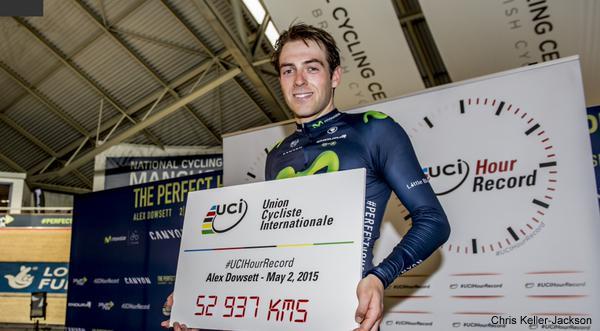
Alex Dowsett – new Hour Record: 52,937 km/h

Alex Dowsett Hour Record

2015 Giro d’Italia Startlist

AG2R: Julien Berard, Carlos Betancur, Axel Domont, Hubert Dupont, Patrick Gretsch, Hugo Houle, Matteo Montaguti, Rinaldo Nocentini, Domenico Pozzovivo.

Androni Giocattoli-Sidermec: Davide Appollonio, Marco Bandiera, Tiziano Dall’Antonia, Oscar Gatto, Marco Frapporti, Franco Pellizotti, Simone Stortoni, Serghei Tvetcov, Gianfranco Zilioli.

Astana: Fabio Aru, Dario Cataldo, Tanel Kangert, Mikel Landa, Davide Malacarne, Luis Leon Sanchez, Diego Rosa, Paolo Tiralongo, Andrey Zeits.

Bardiani: Enrico Barbin, Enrico Battaglin, Francesco Manuel Bongiorno, Nicola Boem, Luca Chirico, Sonny Colbrelli, Stefano Pirazzi, Nicola Ruffoni, Eduardo Zardini.

BMC: Darwin Atapuma, Brent Bookwalter, Marcus Burghardt, Damiano Caruso, Silvan Dillier, Philippe Gilbert, Stefan Küng, Amaël Moinard, Rick Zabel.

Cannondale-Garmin: Janier Acevedo, Nathan Brown, André Cardoso, Tom Danielson, Davide Formolo, Ryder Hesjedal, Alan Marangoni, Tom-Jelte Slagter, Davide Villella.

CCC Sprandi Polkowice: Maciej Paterski, Sylwester Szmyd, Grega Bole, Lukasz Owsian, Marek Rutkiewicz, Branislau Samoilau, Bartlomiej Matysiak, Nikolay Mihaylov, Jaroslaw Marycz.

Etixx-Quick Step: Tom Boonen, Maxime Bouet, David de la Cruz, Iljo Keisse, Gianni Meersman, Fabio Sabatini, Pieter Serry, Rigoberto Uran, Petr Vakoč.

FDJ: Arnaud Courteille, Kenny Elissonde, Alexandre Geniez, Murilo Fischer, Francis Mourey, Cedric Pineau, Kevin Reza, Anthony Roux, Jussi Veikkanen.

Giant-Alpecin: Nikias Arndt, Bert De Backer, Caleb Fairly, Simon Geschke, Chad Haga, Cheng Ji, Luka Mezgec, Tobias Ludvigsson, Tom Stamsnijder.

IAM: Sylvain Chavanel, Clement Chevrier, Stef Clement, Heinrich Haussler, Roger Kluge, Matteo Pelucchi, Jerome Pineau, Sebastian Reichenbach, Aleksejs Saramotins.

Katusha: Maxim Belkov, Sergei Chernetckii, Pavel Kochetkov, Sergey Lagutin, Luca Paolini, Alexander Porsev, Yuri Trofimov, Anton Vorobyev, Ilnur Zakarin.

Lampre-Merida: Roberto Ferrari, Tsgabu Grmay, Sacha Modolo, Manuele Mori, Przemyslaw Niemiec, Jan Polanc, Maximiliano Richeze, Diego Ulissi, Gang Xu.

LottoNL-Jumbo: George Bennett, Rick Flens, Moreno Hofland, Martijn Keizer, Steven Kruijswijk, Bert-Jan Lindeman, Maarten Tjallingii, Nick Van Der Lijke, Robert Wagner.

Lotto-Soudal: Sander Armee, Lars Ytting Bak, Stig Broeckx, André Greipel, Adam Hansen, Greg Henderson, Maxime Monfort, Jurgen Van Den Broeck, Louis Vervaeke.

Movistar: Andrey Amador, Igor Anton, Ruben Fernandez, Jesus Herrada, Beñat Intxausti, Ion Izagirre, Juan Jose Lobato, Dayer Quintana, Giovanni Visconti.

Nippo-Vini Fantini: Giacomo Berlato, Alessandro Bisolti, Daniele Colli, Damiano Cunego, Pierpaolo De Negri, Eduard Grosu, Manabu Ishibashi Alessandro Malaguti, Riccardo Stacchiotti.

Orica-GreenEdge: Sam Bewley, Esteban Chaves, Simon Clarke, Luke Durbridge, Simon Gerrans, Michael Hepburn, Brett Lancaster, Michael Matthews, Pieter Weening.

Sky: Bernhard Eisel, Sebastian Henao, Vasil Kiryienka, Leopold König, Mikel Nieve, Richie Porte, Salvatore Puccio, Kanstantsin Siutsou, Elia Viviani.

Southeast: Manuel Belletti, Matteo Busato, Ramon Carretero, Elia Favilli, Mauro Finetto, Francesco Gavazzi, Yonathan Monsalve, Alessandro Petacchi, Eugert Zhupa.

Tinkoff-Saxo: Ivan Basso, Manuele Boaro, Alberto Contador, Roman Kreuziger, Christopher Juul-Jensen, Sergio Paulinho, Michael Rogers, Ivan Rovny, Matteo Tosatto.

Trek Factory Racing: Eugenio Alafaci, Fumiyuki Beppu, Marco Coledan, Fabio Felline, Giacomo Nizzolo, Fabio Silvestre, Boy van Poppel, Kristof Vandewalle, Calvin Watson.

Navigare în articole